
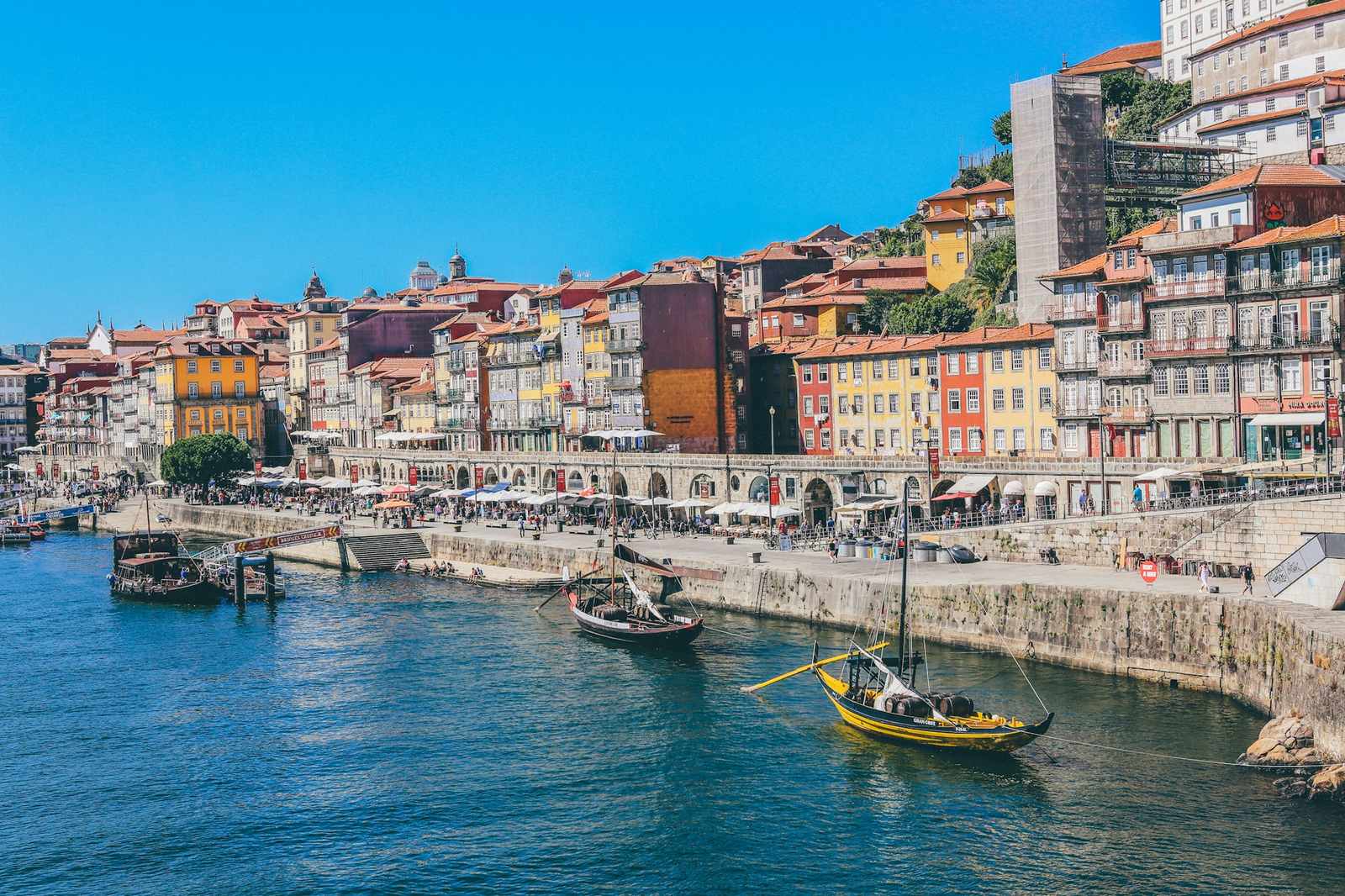
Many moves to Portugal begin with a property search: a flat in Lisbon, a house in Cascais, a place in the Algarve. Lifestyle — light, the sea, proximity to the rest of Europe — is often the real driver. The purchase itself is a formal process, with acquisition taxes, documentary due diligence and, since May 2026, a specific rule for non-resident buyers.
Lifestyle — light, the sea, proximity to the rest of Europe — is often the real driver.
This article sets out the steps, official costs and points to watch. The Living in Portugal guide places the project in daily life, neighbourhoods and schools. The two are meant to be read together.
The market in 2026, in a few official figures
In the second quarter of 2026, INE published a median price of €5,299/m² in the municipality of Lisbon, €5,200/m² in Cascais, €4,704/m² in Oeiras, €4,030/m² in Greater Lisbon, €3,500/m² in the Algarve, €2,669/m² in the Porto metropolitan area, and €2,445/m² for the country as a whole. These are medians of recorded transactions, not asking prices: a particular home can sit well above or below them, depending on the area, condition and outlook.
Year on year, the national median was still up 18.4%, and the House Price Index (IPHab) 16.5%. The number of transactions, meanwhile, fell. In Lisbon municipality, the year-on-year rate of increase slowed from the previous quarter. In Greater Lisbon, buyers with a tax domicile outside Portugal paid a median price 47% higher than buyers tax-domiciled in Portugal (37.5% in the Porto area). Those gaps are a reminder that a buyer coming from abroad is often compared with an “international” market, not with the local median.
Nobody can say whether prices will keep rising. What can be said is that in 2026 the market remains expensive in the most sought-after municipalities, and that a budget should include acquisition taxes, not only the negotiated price.
Before you view: NIF, area, school, a real budget
Three precautions prevent a good many false starts.
First, obtain a NIF (tax number). It is required to sign, to open an account and to pay IMT. A lawyer or tax representative can obtain it even if you are not yet in the country.
Second, settle — at least provisionally — the area and, where relevant, the school before you multiply promissory contracts. In Lisbon and Cascais, the French lycée and several international and British-curriculum schools are tight in some years; in the Algarve there is no AEFE-accredited French lycée. A lease or a deed signed in the “wrong” school radius is paid for over a long time. The destination guide offers neighbourhood pointers.
Third, build a budget that includes, besides the price: IMT, stamp duty (0.8%), notary and registration, legal fees, any agency commission, a survey, and a reserve for works — common in older Lisbon property. A local mortgage, if contemplated, has its own deposit and insurance rules.
The steps in a purchase
1. Search and offer
The market runs largely through agencies and portals. A seller’s agent is not your adviser. It is wise to have your own, licensed, agent and a lawyer as soon as an offer becomes serious. Weekday viewings, at peak hours, tell you more about noise and commuting than a Saturday afternoon visit.
2. Documentary due diligence
Before any substantial deposit, a professional should check, among other things: the land-registry certificate and the description of the property (area, annexes), use licences, planning status (especially for a house, a plot or an older building), condominium charges and any litigation, debts attached to the property, and, for a building under construction or off-plan, the developer’s framework. Gaps between the “marketing” area and the official area are not unusual. On land described as rustic, building rights are not those of an urban plot: do not assume them.
3. Promissory contract (CPCV)
The CPCV sets the price, the conditions, the timetable and, usually, a deposit. Exit clauses (finance, licences, defects) are negotiated here, not at completion. A notarised power of attorney allows you to sign at a distance, provided it is properly drafted and, where required, apostilled. Only pay a deposit onto an account and a contract that your adviser has reviewed.
4. IMT, stamp duty, then the escritura
IMT and stamp duty are in principle settled before the deed (escritura) before a notary. The deed transfers ownership; registration at the land registry makes it binding on third parties. Keep registration deadlines in the timetable: an unregistered deed does not offer the same protection.
IMT and stamp duty: 2026 scales and the 7.5% rule
Two acquisition taxes apply, on a base that is in principle the higher of the agreed price and the taxable patrimonial value:
- IMT, under Article 17 of the Code (bands updated, as to thresholds, by Law No. 73-A/2025 of 30 December);
- Imposto do Selo (stamp duty) at 0.8% (Portal das Finanças documentation).
For a primary and permanent home on the mainland, the 2026 scale exempts up to €106,346, then applies marginal rates of 2%, 5%, 7% and 8%, a single 6% rate between €660,982 and €1,150,853, and 7.5% above that. A home that is not a primary residence follows a slightly less favourable scale from the first euro (1% on the first band). The Azores and Madeira have thresholds raised by 25%.
Under Decree-Law No. 97/2026 of 20 May 2026, when a non-resident buys a residential property, the rate is in principle a flat 7.5%, with no exemption or reduction (new paragraph 10 of Article 17). The text provides three main exceptions:
- the buyer has already been treated as a Portuguese tax resident (Article 16 of the IRS Code);
- they become one within two years of the purchase;
- the property is intended for residential letting, within the rent caps set by the decree, let within six months, for at least 36 months (continuous or not) in the first five years.
In the last two cases the tax authority cancels, on application, the difference between the 7.5% paid and the ordinary scale in paragraph 1. The application is filed within six months of the change of residence or of the lease being signed. It is neither automatic nor retrospective without a file.
Illustrative example, rounded to the euro, excluding notary, agency and works. A price of €530,000 — a rough order of magnitude for about 100 m² at Lisbon city’s median in Q2 2026 (€5,299/m²); the actual price depends heavily on the neighbourhood.
• Primary residence, mainland resident scale: IMT = €530,000 × 8% − €13,763.35 (the official deductible) = €28,637, plus stamp duty of €4,240, or nearly €32,900.
• Non-resident at 7.5%: IMT of €39,750 + €4,240, or about €44,000.
The IMT gap (about €11,100) is the amount that may, subject to conditions, be reclaimed on becoming a tax resident within two years. Above about €1.15 million, the single 7.5% rate also applies to residents for a home: the gap linked to non-resident status then disappears. Have your own case figured: the classification of the property and your residence have a direct effect.
Once you own the property, an annual IMI is due on the taxable patrimonial value, at a rate set by the municipality. Other charges may apply depending on the property portfolio; a local adviser will identify them.
Primary home, second home, buy-to-let
The most favourable IMT scale assumes a “primary and permanent” home. Buying as a second home, or simply before you have transferred your residence, in principle places the transaction in another regime — and, for a non-resident, in the 7.5% rate until any later regularisation. If the plan is genuinely to move, the timetable (purchase, transfer of residence, refund application) should be set with a lawyer before the CPCV, not after.
If the plan is to let the property, the income falls under specific rules (special rates, sometimes reduced for certain residential rents, an option for a professional regime). The May 2026 decree also provides an IMT-refund route linked to residential letting within rent caps. All of this interacts with the tax treaty and with your tax residence: it is not a matter to be settled on the strength of a yield illustration alone.
The Golden Visa is no longer a reason to buy
The residence permit for investment (Article 90-A) no longer admits a real-estate route. AIMA still maintains other qualifying investment routes, including funds that meet legal criteria. A property purchase in Portugal should be justified by housing, by family use or by a letting project taken as such — not by that visa. Be wary of offers that still loosely tie “property investment” to residence.
Common pitfalls
- Signing a CPCV too quickly, with a large deposit, before due diligence is finished and without clear exit clauses.
- Confusing marketing area with official area, or buying off-plan without a completion and guarantees framework reviewed by a lawyer.
- Assuming building rights on a rustic plot or a house to renovate, without planning confirmation.
- Under-budgeting IMT by mistakenly applying the primary-residence scale while you are still a non-resident.
- Overlooking service charges and the building’s condition, especially in older stock (roof, condominium, damp, electrics).
- Paying in a foreign currency without agreeing with your bank the timing and cost of the exchange: on several hundred thousand euros, a few points of FX can outweigh a good many notary fees.
After the deed
Registration remains, as do utilities, IMI, and, if you are moving, residency formalities (an EU-citizen certificate for EU nationals; a visa and permit for British nationals), SNS registration, and possibly an IMT refund if you become a tax resident within two years. A change of tax residence, on either side of the border, is a separate subject — treaties, and UK or French departure rules as the case may be — to be handled with a professional, in parallel with the purchase, not as a formality of the deed.
Frequently asked questions
How much should I budget for purchase taxes on top of the price?
At a minimum, budget for IMT and 0.8% stamp duty. IMT depends on residence status, whether the home is a primary residence, and the price. A non-resident is in principle charged 7.5% IMT under Decree-Law No. 97/2026. Notary, registration, legal fees and any agency commission come on top. On an illustrative €530,000 example, IMT plus stamp duty alone runs from about €33,000 (primary residence, resident scale) to about €44,000 (non-resident at 7.5%).
Can I reclaim the difference if I become resident after buying?
Yes, subject to conditions. If you become a Portuguese tax resident within two years of the purchase, you may apply, within six months of that change, for cancellation of the difference between the 7.5% paid and the scale that applies to a resident (Article 17, paragraphs 10 to 12, of the IMT Code). Another route exists if the property is let for housing within specified rent caps and for a minimum period. It is not automatic: a file is required, and the conditions must actually be met.
Do I need to be in Portugal to buy?
No. Many buyers complete at a distance, often under a notarised power of attorney. You will still need a NIF, thorough due diligence on the property, and someone you trust (a lawyer independent of the seller) to run the file. A first visit, including outside a weekend, remains highly desirable.
Is a Golden Visa still a reason to buy property?
No. Direct real estate is no longer an eligible route for a residence permit for investment. A purchase should be justified by housing or by a letting project, not by that visa. Other investment routes remain open, on the terms published by AIMA.
Will prices keep rising?
Nobody can promise that. In the second quarter of 2026 INE still recorded high year-on-year increases (national median +18.4%, House Price Index +16.5%), with fewer transactions and a slower rate of increase in Lisbon municipality. Those are observations, not a forecast.
Are you planning a purchase or a move to Portugal?
Leave your details and we can talk through the practical side — area, type of property, timetable, formalities. A personal conversation, with no obligation.
Read the Living in Portugal guide · Destination ranking tool