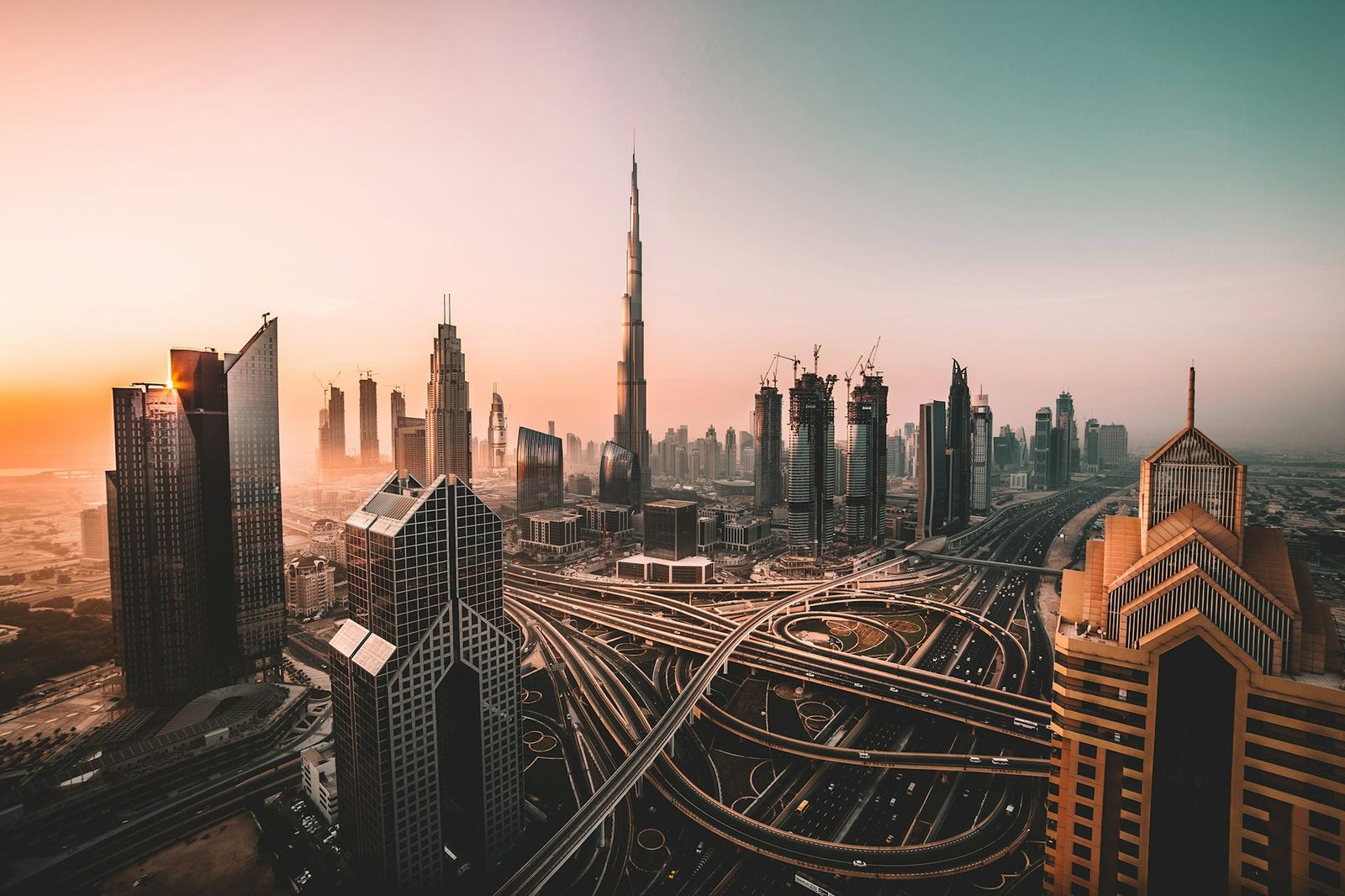
Many plans to settle in Dubai start with a housing question: a waterfront apartment, a villa in a family community, a unit still on the plan. Daily life — climate, schools, commuting, the rhythm of the year — is often the real driver. The purchase itself is a formal process with the Dubai Land Department (DLD), with official registration fees, a trustee appointment, and clear differences between a ready property and an off-plan unit.
This article sets out the steps, the fees published by the DLD, and the points to watch. The Living in the UAE (Dubai) guide places the project in daily life, neighbourhoods and schools. The two pages complement each other. This article does not cite “average prices” from private aggregators: the gaps from one community to another are too wide. The DLD publishes indices and a transactions dashboard — that is the reference to consult, with a professional, for the area you have in mind.
Rent first, or buy straight away?
Dubai’s rental market is deep and liquid in most communities, with leases often of one year and local practice (cheques, a deposit, agency commission) that a licensed agent will explain. Renting for a first year lets you test the school, weekday commuting and the summer — considerably more demanding than a winter stay. A purchase decided only on weekend viewings, without that trial period, can be costly in charges and in quality of life.
That does not rule out buying earlier, especially if the neighbourhood and school are already settled, or if you already know the city well. In every case, the budget should include DLD fees, community service charges and, for off-plan, the payment schedule — not only the advertised price.
Freehold: where can a foreign buyer acquire title?
Foreign buyers can acquire freehold title in designated areas. Outside those areas the regime is different; a licensed agent and counsel will confirm the exact status of the property (freehold, leasehold, or otherwise). The sale is registered with the DLD, typically at a Real Estate Registration Trustee centre, or through the emirate’s digital services (including the Dubai REST app, for some formalities).
Work with a RERA-licensed agent (Dubai’s real-estate regulator). The seller’s or developer’s agent is not your adviser. For a meaningful amount, advice independent of the transaction — including a contract review and, for a ready property, a technical inspection — is ordinary diligence.
Official Dubai Land Department fees
According to the DLD’s official Property Sale Registration page, and the tariff approved by Executive Council Resolution No. (30) of 2013:
- the sale registration fee is 4% of the value. Unless otherwise agreed, it is shared equally (2% seller, 2% buyer). In practice, many contracts put most or all of it on the buyer: read that clause before you sign — it weighs more than most of the fixed fees;
- there is also a title fee (AED 250), a map fee (AED 250 for villas and apartments; other amounts in some cases, including AED 225 for a unified Dubai Municipality map), and knowledge and innovation fees (AED 10 + AED 10);
- trustee (registration partner) fees: AED 4,000 plus VAT if the value is at least AED 500,000, AED 2,000 plus VAT below that.
If you are borrowing, mortgage registration fees also apply, under the DLD’s tariff (a percentage of the loan amount, plus title and trustee fees specific to the mortgage). Have them costed by the bank and the trustee, rather than relying on an advertised yield or an “all-in” figure. VAT on the price of a completed residential dwelling, and agency commission, sit under separate rules and practice: a professional will place them for your file. The amounts above are those published by the DLD at the time of writing; check them on the day of the transaction.
Ready property or off-plan
A ready property can be viewed, inspected, and sometimes financed more straightforwardly. Points to watch include its technical condition, service charges (community fees, sometimes high — ask for them in writing), the community’s rules, and obtaining a no-objection certificate (e-NOC) from the developer in the relevant areas, through the channels indicated by the DLD (including Dubai REST).
An off-plan unit (on the plan, or under construction) accounts for a large share of registered transactions. It can come with staged payment plans that ease the initial outlay, but also with risks: delivery delays, a gap between the brochure and what is handed over, quality, and a resale that is sometimes less liquid until the building is complete. Check the escrow framework, registration of the contract (including, for some units under construction, the Oqood system), the developer’s record, and the delay and termination clauses. Do not sign on a showroom visit alone.
The two markets should not be blended in the statistics: an “average” price that merges them is of little use. Compare like with like, in the same community, with the same status (ready or not).
The steps in a purchase
1. Community, school, real budget
Settle — at least provisionally — on the community and, where relevant, the school before you multiply reservations. Lycée français international Georges-Pompidou (Academic City, Oud Metha) and many British or IB schools, regulated by the KHDA, have waiting lists. The destination guide offers orientation (Marina and Downtown more urban; Dubai Hills, Arabian Ranches, Jumeirah, Mirdif more family-oriented; Abu Dhabi as an alternative). Visit on a weekday, at school-run hours, and take the summer into account.
The real budget includes the price, the 4% (as the contract provides), the trustee, any commission, a deposit, the first year’s service charges, and a reserve for furnishing — common on “shell and core” or lightly fitted deliveries.
2. Offer and contract
The offer and the sale contract (often a standard form, sometimes called Form F on a resale) fix the price, the timetable, how DLD fees are shared, and any withdrawal terms. Have them reviewed by counsel who is not paid only for completing the sale. A valid passport (or an Emirates ID for residents) will be required for registration.
3. NOC, payment, trustee, title
On many resales in a developer’s area, an e-NOC is required. Funds — including DLD fees — are settled in the ways accepted by the trustee centre (a manager’s cheque, a card, an electronic payment). The trustee records the transaction, collects the fees and submits the file. The title deed is then issued; a copy is usually sent electronically. Keep every receipt. For an off-plan unit, the payment schedule and contract registration follow their own procedures: do not improvise them from a resale.
4. Financing
A mortgage may be available to residents, on terms that sit with the banks and the central bank (deposit, rate, insurance, mortgage registration fees). Confirm what the bank actually finances: some costs (DLD fees, commission) may have to be paid outside the loan. A non-resident does not automatically have the same access to credit. Cost this before you commit to a property.
Charges, management and life after completion
Service charges fund the community’s upkeep (common parts, security, sometimes district cooling, a pool, and so on). Ask for the history and the current year’s budget; a low first-year figure is not a guarantee. Once you own, letting the property, if you do not occupy it, is a professional job: a clear mandate, a licensed agent, and a reading of the emirate’s tenancy rules (including lease registration) avoid unpleasant surprises.
A Dubai purchase is also the moment to think about succession. There is no federal inheritance tax comparable to UK inheritance tax, but the law that applies to property in the UAE can raise important questions. Many non-Muslim residents formalise their wishes in the DIFC or ADGM frameworks, with a solicitor — ideally at the time of the move or the purchase, not “later”.
Visa and Golden Residency: two separate files
A property purchase does not automatically confer a residence title. The ten-year Golden Residency, set out by the ICP (page updated 10 September 2026), is aimed at defined categories (investors, entrepreneurs, talent, and others) under published criteria, which change. Some routes go through an investment — including, where relevant, property — but the thresholds and conditions are those of the authority, not those of a sales brochure. Treat the visa with competent advice, separately from the sale contract.
Common pitfalls
- Signing too quickly an off-plan contract on a brochure, without escrow, without the developer’s record and without delay clauses reviewed.
- Underestimating the 4% in the belief that it will be shared, when the contract puts it on you.
- Ignoring service charges and the community’s rules, especially in towers and gated developments.
- Buying the postcard neighbourhood (Marina, Palm) without having measured the school run and the summer.
- Confusing a visa with a title deed: one does not carry the other.
- Paying in foreign currency without having fixed with your bank the timing and cost of the exchange: on several million dirhams, a few points of FX add up.
- Neglecting a will for property situated in the UAE.
Frequently asked questions
What official fees sit on top of the purchase price in Dubai?
According to the Dubai Land Department’s official Property Sale Registration page, the sale registration fee is 4% of the sale value, in principle split 2% buyer and 2% seller unless agreed otherwise — many contracts put most or all of it on the buyer. Add AED 250 for the title deed, AED 250 for a map on villas and apartments, AED 10 + AED 10 knowledge and innovation fees, and trustee fees: AED 4,000 plus VAT if the value is at least AED 500,000, AED 2,000 plus VAT below that. Agency commission, a deposit and, where relevant, mortgage registration fees also apply. Read the contract before you sign.
In practice, many contracts put most or all of the 4% registration fee on the buyer: read that clause before you sign.
Can a foreign buyer acquire freehold title?
Yes, in designated freehold areas. The sale is registered with the DLD. Work with a RERA-licensed agent and with advice independent of the transaction, especially for an off-plan unit.
Should I buy straight away or rent first?
Many newcomers rent for a first year, to settle on a school and a community, before they buy. The rental market is deep. A purchase decided only on a weekend of viewings, without having tested weekday commuting, can be expensive in charges and in daily life.
What are the main off-plan risks?
Off-plan makes up a large share of transactions and can come with attractive payment plans, but also with delivery delays, quality questions and less certain liquidity on a resale. Check the escrow framework, the developer’s record and the contract, and do not sign on a brochure alone.
Does a purchase automatically confer a visa?
No. Some investor categories may be eligible for Golden Residency under the rules published by the ICP, but a purchase on its own is not enough without checking the criteria in force. The visa and the purchase are two separate files.
Who pays the 4% DLD registration fee?
The official tariff splits it equally, unless otherwise agreed (Executive Council Resolution No. 30 of 2013 and the DLD page). In practice, many contracts put all or most of it on the buyer. That is a clause to read before you commit, not afterwards.
Are you looking at a purchase or a move to Dubai?
Leave your details to discuss the practical side — community, type of property, timetable, formalities. A personalised conversation, with no obligation.
Read the Living in the UAE (Dubai) guide · Destination ranking tool