
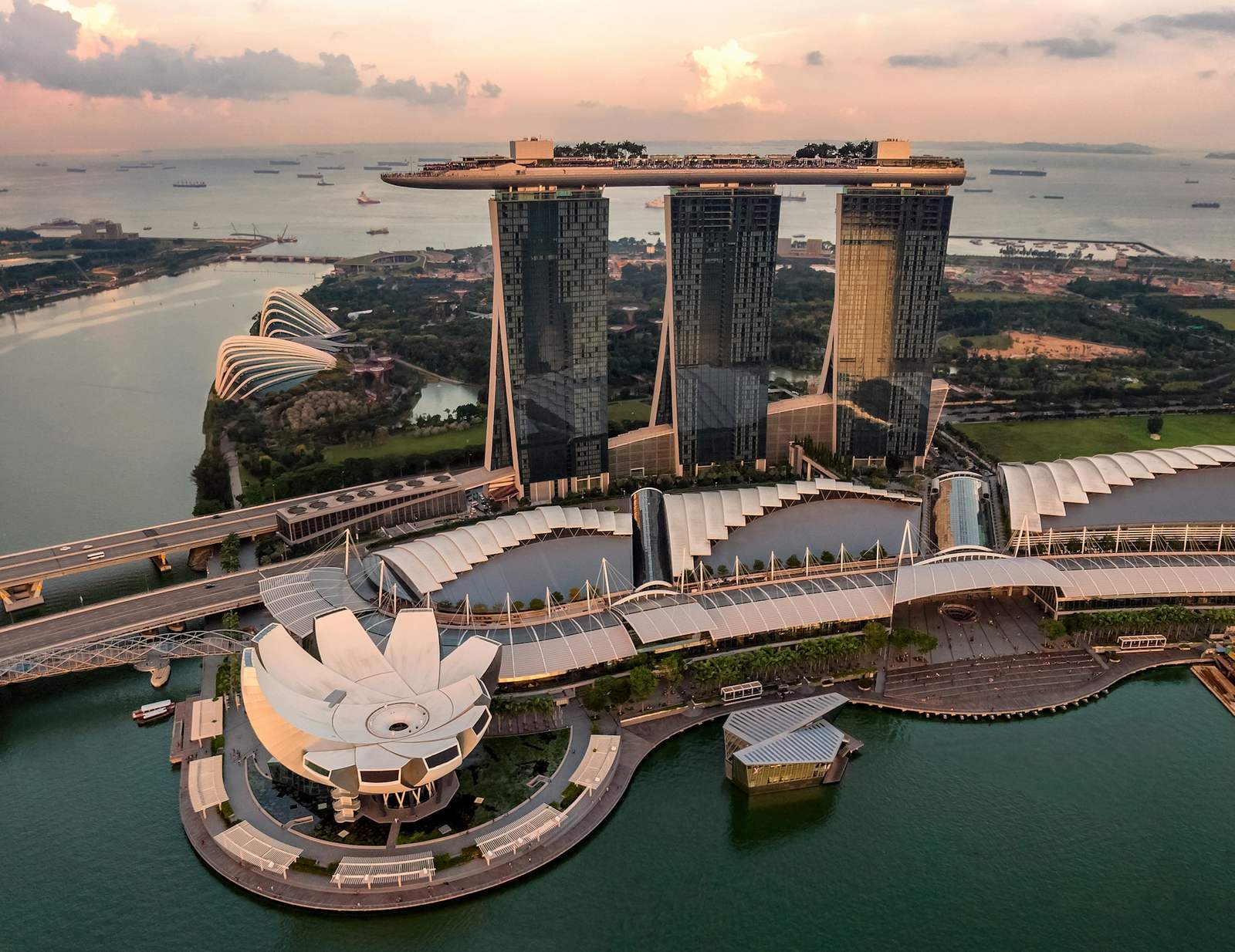
In 2026, Singapore remains a leading destination for families and professionals who want an English-speaking base in Asia that is safe, extremely well organised, with international schools and an airport to the whole continent. People come first for that way of life — greenery, efficiency, the sea close by — and for a job or a business project. Tax, often judged attractive, and the real cost of a property purchase (especially ABSD for foreigners) come next, once the neighbourhood, the school and the residence pass are a little clearer.
This guide covers daily life, neighbourhoods, official URA indices, the purchase framework, schools, formalities and, as a second layer, tax. For another example of a purchase in an international Asian city, you may also read our article on buying a home in Dubai.
Lifestyle and everyday life
Singapore is a tropical city-state, hot and humid all year, dense, green, and of a cleanliness and safety rarely matched. English is a working and official language, alongside Mandarin, Malay and Tamil. The metro (MRT), buses and taxis cover a tiny territory; a car is expensive and deliberately constrained (certificate of entitlement, road pricing). Daily life is urban, efficient, sometimes felt to be strict: the rules are part of the social contract, and it is better to accept them from the start.
The food scene, the parks, the beaches of East Coast or Sentosa, and a dense cultural calendar make up for the size of the territory. Weekends often extend into Malaysia (Johor) or, a step further, towards other Asian capitals. The cost of living, on top of already high housing, is that of a financial centre: restaurants, international schools and private care weigh on a family budget.
The professional pace can be demanding. Many foreign residents are tied to an Employment Pass or a dependant status: residence is not “acquired” in the same way as a European residence. That framework should be built into the plan from the start, before the choice of apartment.
Where to live: Orchard, Bukit Timah, East Coast, Holland Village
Orchard, River Valley, districts 9, 10 and 11
The “prime” core — Orchard, River Valley, districts 9, 10 and 11 — concentrates sought-after condominiums, services, and maximum access to the centre. You pay for centrality and, often, high condo charges. The profile is urban, international, practical for a couple working in the Central Business District or around Marina Bay.
Bukit Timah, Holland Village, around the lycée
Bukit Timah and the neighbourhoods towards Holland Village, Dempsey or the Lycée français de Singapour attract many families: a little more space, proximity to schools, parks, a daily life a little less “touristy” than Orchard. Journey times, by MRT or car, should be measured at peak hours. It is often the school-and-home pair that decides, more than a ranking of districts.
East Coast, Katong, Marine Parade
East Coast, Katong and Marine Parade offer the sea, a neighbourhood life, Peranakan food, and a slightly more open pace. The journey to the centre and to certain schools is the criterion to check. Family condominiums are sought after there, in a market where the type of title (private, inherited, any restrictions) should be examined file by file.
Marina Bay, Sentosa, the north and north-east
Marina Bay is a spectacular waterfront, more “skyline” than family neighbourhood life. Sentosa attracts for gated residences and the sea, at the price of particular access and cost. The north and north-east (including more residential, sometimes more approachable areas) suit those who accept a longer commute and a less central daily life. In every case, the type of property (condo, landed, or Housing & Development Board for those eligible) completely changes the market: foreigners do not have access to the whole HDB stock on the same terms as citizens or certain permanent residents. Official HDB and URA rules are authoritative.
Advantages and points to watch
Advantages
- A safe, green, extremely well organised city-state, with English as a working language.
- An air hub to the whole of Asia, and a dense cultural and food scene.
- The Lycée français de Singapour (AEFE network) and many international schools.
- A predictable legal and tax framework (IRAS), without a capital-gains or estate tax comparable to France’s.
- High-quality infrastructure and private care, for those who insure themselves properly.
Points to watch
- A cost of housing and of daily life among the highest in Asia, especially for families.
- ABSD on foreign buyers of residential property is very high (IRAS table, 60% since 27 April 2023, subject to any later update and to certain FTA remissions).
- Residence depends on a pass (Employment Pass, and others): there is no generic retirement visa comparable to some other countries in the region.
- A hot, humid equatorial climate all year; a highly urbanised pace on a tiny territory.
- Strict social and administrative rules, to be accepted as a framework, not as an anecdote.
Property: URA indices for 2026 and ABSD
This page does not repeat an “average price” from agencies. The Urban Redevelopment Authority (URA) publishes the official private residential property price index, and rental statistics, by segment and by area.
According to URA statistics for the second quarter of 2026, prices of private homes rose by 0.5% on the quarter, after +0.9% in the previous quarter. Landed property rose by 2.5% (after a slight fall in the previous quarter); non-landed property fell by 0.1%. By area, non-landed property in the Core Central Region (CCR) rose by 1.8%, in the Rest of Central Region (RCR) it fell by 1.2%, and in the Outside Central Region (OCR) by 0.1%. Rentals of private homes rose by 0.7% on the quarter.
On 1 October 2026, URA published a flash estimate for the third quarter: the index would rise by 1.4% on the quarter, after the 0.5% of the second. A flash estimate may be revised in later detailed statistics.
The cost of a purchase for a foreigner is not just the index. Additional Buyer’s Stamp Duty (ABSD), administered by IRAS, is added to ordinary stamp duty, according to the buyer’s profile (citizen, permanent resident, foreigner, whether the property is a first or later purchase). At the tightening of 27 April 2023, the rate applicable to foreign buyers of residential property was set at 60% in the published table — a level that can, on its own, make a purchase of little relevance. Certain remissions exist under free-trade agreements, including, according to the IRAS texts, for some Swiss and US nationals. Check the IRAS table in force on the day of your offer: this page does not freeze a rate that a later update might change. A local lawyer and tax adviser are essential before any booking.
Schools and family life
The Lycée français de Singapour, an AEFE-network school, is the anchor for French-speaking families. Admissions, fees and places should be checked directly with the school and with AEFE. This page does not publish a pupil headcount. Many international schools, often heavily in demand and costly, complete the offer, with British, American or international curricula. It is wise to open the files a year ahead, sometimes more.
Family life rests on condominiums with facilities, parks, and a very safe environment. The climate and the school calendar (often different from the French one) are part of the adaptation. The school budget, in the international sector, is a major item, to be treated on the same level as the rent.
How many French nationals in Singapore?
At 1 January 2025, the register of French nationals established outside France recorded 11,498 enrolments in Singapore, after 12,196 in 2024 and 14,682 in 2019. The series, after a plateau around 14,500–14,700 in the late 2010s, has been trending downwards. Registration is voluntary: these official counts understate the actual community, which is long established and organised around the lycée, companies and associations.
Registration on the register of French nationals established outside France is voluntary. These official counts therefore understate the actual community. Source: French Foreign Ministry, community CSV files, registrations at 1 January.
Residency, formalities and healthcare
Residence for foreigners rests mainly on passes issued by the Ministry of Manpower and ICA: Employment Pass (with the COMPASS framework), S Pass, EntrePass, dependant passes, and, for some, permanent-resident status. There is no generic retirement visa comparable to those of some neighbouring countries. The criteria (salary, qualifications, sector) change; official pages are authoritative.
Healthcare, for most foreign residents, goes through good-quality private insurance: public care exists, but an expatriate’s path relies largely on the private sector, which is of a high standard and expensive without suitable cover. It is wise to check benefits (hospitalisation, evacuation, maternity) before arrival, especially with children.
Tax in 2026 — what is useful to know next
IRAS administers a personal income tax which, in principle, is territorial, with particular rules for certain foreign-source income. Tax residents fall under a progressive scale published by IRAS. There is not, as a general rule, a tax comparable to French personal capital-gains tax, nor a French-style inheritance tax (estate duty has been abolished). GST applies to consumption, at the rate in force (9% in the recently applicable table; confirm the current rate on IRAS). The treaties (France–Singapore, United Kingdom–Singapore) frame residence and double taxation.
If you leave France, the French exit tax on certain unrealised gains may apply. A departure outside the European Union does not, in principle, benefit from the automatic deferral available within the EU: guarantees or other conditions may be required. The impots.gouv.fr page (updated on 10 March 2026) is the starting point; a proposal to extend the period to fifteen years is not in force. Have your position reviewed by an adviser.
A Singapore plan should be built in this order: a realistic residence pass, a school, a home — often rented, given ABSD — then a precise tax review. A purchase is not a prerequisite, and it should not be decided on the memory of an old duty table.
Frequently asked questions
How many French nationals live in Singapore?
At 1 January 2025, the French Foreign Ministry’s voluntary register recorded 11,498 enrolments in Singapore, after 12,196 in 2024 and a high of 14,682 in 2019. The series has been trending downwards for several years. Registration is voluntary: these counts understate the actual community.
Can a foreigner buy a home in Singapore?
Yes, subject to conditions, but the tax cost can be decisive. In addition to ordinary stamp duty, Additional Buyer’s Stamp Duty (ABSD) applies according to the buyer’s profile. For a foreign buyer of residential property, the rate published at the 27 April 2023 tightening is 60%, subject to any later IRAS update and to certain free-trade-agreement remissions (including, under the texts, for some Swiss and US nationals). Check the IRAS table in force before any offer.
What do the official price indices say?
The Urban Redevelopment Authority (URA) publishes the private residential property price index. In the second quarter of 2026, prices rose by 0.5% on the quarter (after +0.9% in the previous quarter): +2.5% for landed property, −0.1% for non-landed; +1.8% in the Core Central Region, −1.2% in the Rest of Central Region, −0.1% in the Outside Central Region. Rentals rose by 0.7%. The third-quarter flash estimate, published on 1 October 2026, indicates a 1.4% quarter-on-quarter rise. These figures describe a change, not an average price in Singapore dollars per square metre.
Is there a retirement visa?
Singapore does not offer, on the same terms as some neighbours, a generic retirement visa. Residence for foreigners rests mainly on passes linked to employment (Employment Pass, S Pass), to entrepreneurship (EntrePass), to permanent-resident status or to dependant passes. The rules, including the COMPASS framework for Employment Passes, are on the Immigration & Checkpoints Authority (ICA) and Ministry of Manpower pages. They change.
Where can children go to school?
The Lycée français de Singapour, an AEFE-network school, is the anchor for French-speaking families. International schools, often costly and in demand, complete the offer. Applications should be prepared well in advance. This page does not publish pupil numbers.
How is an individual taxed?
IRAS administers personal income tax. The system is, in principle, territorial, with particular rules for certain foreign-source income. There is not, as a general rule, a tax comparable to French personal capital-gains tax, nor a French-style inheritance tax (estate duty has been abolished). GST (value-added tax) applies to consumption. Scales and any exemptions should be read on the IRAS website, at the date of your plans, and confirmed with an adviser.
Are you thinking of moving to Singapore?
Leave your details and we can talk through the practical side of your plans — area, housing, schools, formalities. A personal conversation, with no obligation.