
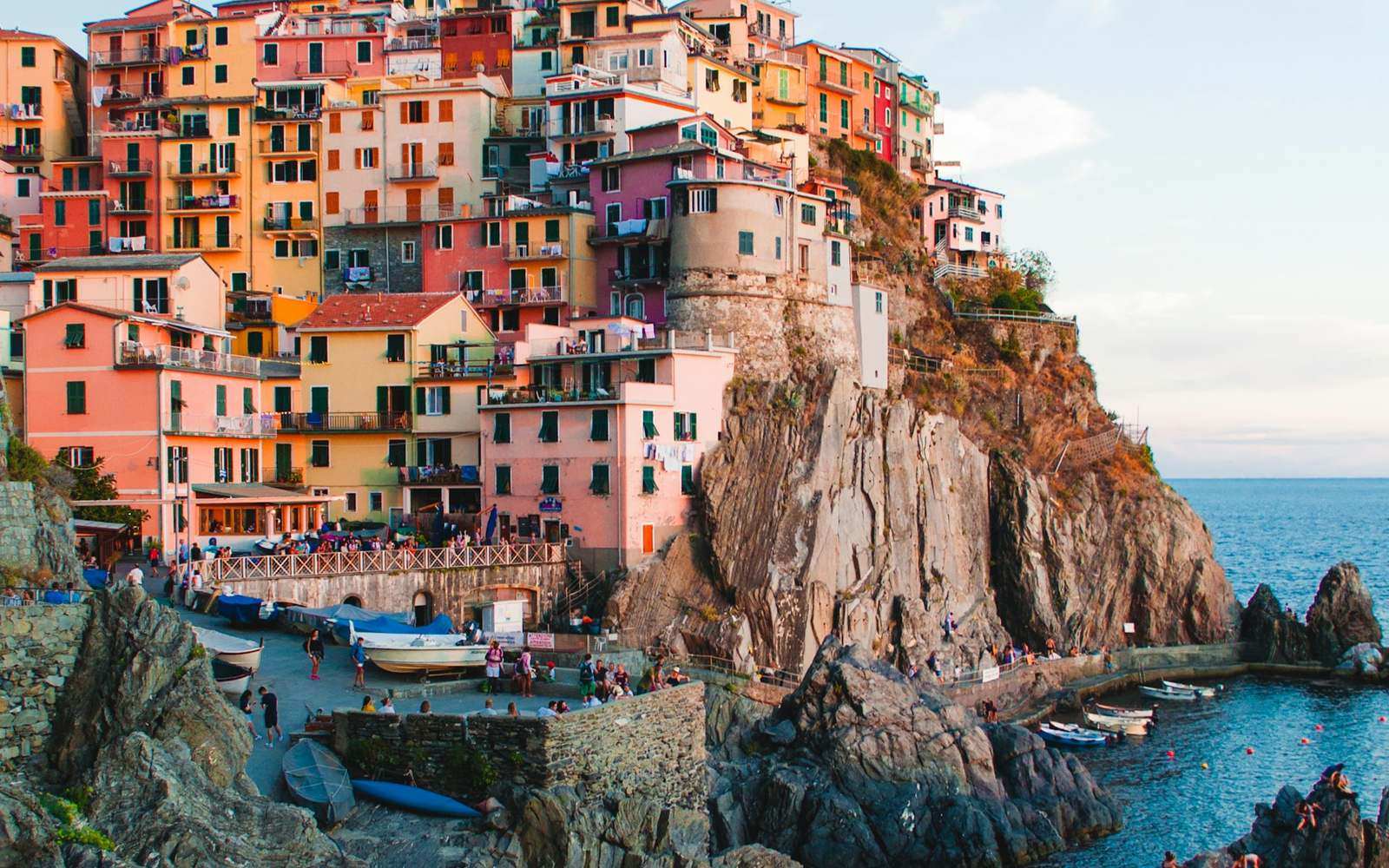
Italy attracts first through a way of life: its historic cities, the light of Tuscany, the northern lakes, a food culture that needs no introduction, and real proximity to the rest of Europe — by high-speed train, by road through the Alps, or on a short flight. Many families and people changing pace start by asking where to live — Milan, Rome, Florence, a lake, the countryside — and how to rent or buy, well before they open the tax chapter. That chapter exists, including the optional flat-tax regime for new residents, and it is covered further down, once daily life is a little clearer.
This guide covers lifestyle, the official property market (ISTAT’s index for the second quarter of 2026), purchase costs, schools and formalities. There was not yet an Italy page on the site: links from other guides can point here once it is published.
Lifestyle and everyday life
Daily life in Italy changes a good deal depending on whether you live in Milan, Rome, Florence or by a lake. The north is more continental, sometimes foggy in winter, with the Alps close at hand; the centre and south are more Mediterranean. High-speed trains link Milan, Bologna, Florence and Rome in times comparable to a London-to-Manchester or Paris-to-Lyon run: a foothold in two cities is practicable. Flights to London, Manchester, Paris and Geneva are frequent; Turin and Liguria put the French border a few hours’ drive away.
The quality of the table, neighbourhood life (the piazza, the market, the café) and an exceptional cultural heritage weigh heavily in the decision — often more than any tax scale. Day-to-day safety is generally regarded as good in residential areas; as elsewhere, very touristy centres call for ordinary caution.
Italian is the language of administration, healthcare and most shops. English is common in international circles in Milan and Rome, and in parts of the tourist economy; it is much less so once you leave those circles. Learning Italian is not a precondition, but it is an investment you feel from the first appointments.
On healthcare, residents register with the Servizio Sanitario Nazionale (SSN) and receive a tessera sanitaria, through their local ASL. Hospital provision is solid in the large cities; many families take out private insurance as well, especially while registration is being completed. A UK Global Health Insurance Card can help with medically necessary care on a temporary stay; it is not a substitute once you live in Italy. After Brexit, long-term healthcare arrangements should be checked with a professional before you rely on them.
Where to live: Milan, Rome, Florence, the lakes
The “right” place depends on the school, the pace you want and a housing budget that varies sharply from one city — and one neighbourhood — to the next.
Milan
The economic capital, international, more “European” in its rhythm. Brera, Isola, Porta Nuova, the Duomo area or first-ring towns (such as Monza) do not offer the same daily life or the same budget. The Lycée Stendhal and several international or British-curriculum schools often shape families’ choices. Winters are colder than in Rome; the lakes and the Alps are close for the weekend. It is also, lastingly, one of the tightest property markets in the country.
Rome
A larger, lighter capital, with a different pace. Residential districts (Prati, Parioli, Monti, the area around the Lycée Chateaubriand towards Porta Pia, or comunes a little further out) make family life possible, provided you accept journeys that can be long. The historic centre is magnificent and heavily touristed. The administration has a reputation for slowness: it is better to budget for it than to meet it as a surprise.
Florence and Tuscany
Florence appeals for its human scale, its setting and the Lycée Victor Hugo. Prices are high for a city of that size, and tourism weighs on the centre. Around it, the Tuscan countryside (Chianti, the hills) attracts people who want space — with a different relationship to services, the car and school. A “house in Tuscany” project should be prepared as a rural purchase: licences, the cadastre, services, not only a view.
The northern lakes, Turin, elsewhere
Lake Como, Lake Maggiore and Lake Garda offer a much-sought-after setting, accessibility from Milan or Verona, and a marked seasonal pattern. Turin, close to France, has a French lycée, a fine urban setting and, in the second quarter of 2026, the strongest year-on-year price rise among the cities for which ISTAT publishes the IPAB (see below). Venice, Bologna, Naples and Liguria answer other kinds of plans: each is worth a visit out of season, not only a weekend of beautiful light. There is a long-established British presence in parts of Tuscany and on the lakes; this page does not cite a headcount, as the UK authorities do not publish a comparable official figure.
Advantages
- A rich cultural and daily life, and genuine regional variety
- Easy links to the UK and the rest of Europe (flights, trains, the Alps)
- French lycées in Milan, Rome, Florence, Turin and Naples, plus international and British-curriculum schools
- A high-speed rail network between the main cities
- A deep property market, from historic centres to the countryside
- For EU citizens, freedom of movement and relatively straightforward formalities
Points to watch
- Bureaucracy that can be slow (anagrafe, cadastre, building work, healthcare)
- High and uneven prices in Milan, Florence and some Roman districts
- Italian is genuinely useful outside international circles
- Congestion and travel times in the large cities
- Demanding documentary due diligence on a purchase
- The new-resident tax regime is an option, not automatic, and became more expensive in 2026
Property: what official figures say in 2026
ISTAT publishes a house-price index (IPAB), which measures the change in prices, not a single price per square metre. According to provisional data for the second quarter of 2026 (release of 17 September 2026):
- the national IPAB rose 1.7% on the quarter and 4.0% year on year (after 5.1% in the first quarter);
- new dwellings were up 5.0% year on year, existing dwellings 3.7%, both slowing;
- the annual rise was stronger in the Centre (+5.1%) than in the North-East (+4.2%), the North-West (+3.9%) and the South and islands (+2.6%);
- among the cities published: Turin +8.5% year on year, Rome +6.4%, Milan +2.4% (a sharp slowdown after +7.1% in the previous quarter);
- residential transaction volumes were broadly stable (+0.1% year on year according to the Revenue Agency’s Property Market Observatory, OMI).
The average 2026 increase in the IPAB already “acquired” at the end of the second quarter, as calculated by ISTAT, was +3.8%. These are observations, not a forecast.
For a price per square metre, the official reference is the Revenue Agency’s OMI database (latest semester published as at the 15 October 2026 update: first half of 2026). It gives, for each homogeneous zone, a min/max range by property type and condition — expressly “broad indications” that do not replace a specific valuation. Gaps inside a single city are very large (a historic centre or a prized district has little in common with an outer area). This page therefore does not quote an “average price” from private aggregators. Consult the OMI, and a local professional, for the area you are considering.
Buying a home: process and costs
The Italian path almost always goes through a notaio, who authenticates the deed (rogito), pays the taxes and handles cadastral and land-registry formalities. Before that: obtaining a codice fiscale, cadastral and mortgage searches, an energy-performance certificate (APE), checks on licences, condominium charges and planning compliance — especially in older stock, which is common in historic centres. An offer and then a contratto preliminare (preliminary contract), which should be registered, usually precede the deed. A lawyer or notary independent of the seller is strongly advisable. A power of attorney allows you to complete at a distance, if it is properly drawn up.
Purchase taxes depend on the seller (private individual or company), on VAT and on “prima casa” relief. According to the Agenzia delle Entrate and the National Notarial Council:
- Purchase from a private seller (or a company selling VAT-exempt): registration tax of 2% with prima-casa relief (minimum €1,000), or 9% without it; mortgage and cadastral taxes of €50 each.
- VAT sale (often a new home from a developer): VAT of 4% with prima casa, generally 10% without the relief, plus €200 registration, €200 mortgage and €200 cadastral tax. Other VAT rates may apply depending on the nature of the property; the notary will state the exact rate.
On private sales, an individual buyer may ask for the prezzo-valore mechanism: registration tax is then calculated on the cadastral value (the revalued cadastral income, multiplied by a legal coefficient: 110 after a 5% uplift for a prima casa, according to the Agency), even if the price paid is higher. That is often materially favourable. The minimum registration tax remains €1,000.
Prima casa relief is not automatic. The home must belong to certain cadastral categories (the administration publishes the list: it does not include, in particular, some prestige categories). It must be in the municipality where the buyer has residence, or where they undertake in the deed to transfer residence within 18 months. Relief is lost in particular if that transfer does not take place, or if you sell within five years without buying again on the terms provided. For someone who buys before moving, this timetable should be set before the preliminary contract, with a notary.
Once you own the property, an annual municipal tax (IMU) applies, on rules and rates set by each comune; a primary residence is often treated more favourably, outside certain categories. A local adviser will be more precise than a general page. Notary and agency fees come on top of the taxes: have them quoted, as they vary with the file.
Schools and family life
The AEFE network in Italy is relatively dense for a European country. Three schools cover the full curriculum, with pupil numbers published by the Agency: the Lycée Chateaubriand in Rome (1,458 pupils), the Lycée Stendhal in Milan (1,156 pupils) and the École française de Florence – Lycée Victor Hugo (412 pupils). The AEFE directory also lists the Lycée français international Jean-Giono in Turin, an Alexandre-Dumas annex in Naples, and other schools in Rome (including the Institut Saint-Dominique and La petite école française). Check the official directory and the schools’ own sites for fees — they change every year — and for admissions. Places are limited: apply early.
Milan, Rome and Florence also have international, British-curriculum and IB schools. The Italian state system is an option, especially for younger children if language is not a barrier. As elsewhere, the school often determines the neighbourhood, not the other way around.
The international community
There is a long-established British presence in parts of Tuscany, on the lakes and in the large cities, alongside a sizable French-speaking community. The UK authorities do not publish a comparable, up-to-date official headcount of British nationals by country, so this page does not cite a figure for Britons in Italy.
For context, the French consular register — voluntary, and therefore an under-count — recorded 35,432 French registrations in Italy on 1 January 2025, after 34,804 a year earlier (+1.80%). The series shows a decline from 43,877 in 2017 to 33,130 in 2022, then a gradual recovery (French Foreign Ministry official CSVs). The community is long-standing and spread across Rome, Milan, the north and Tuscany, with schools and associations that make arrival easier.
Residency and practical formalities
EU citizens enjoy freedom of movement. After three months they register with the municipal anagrafe and complete residence formalities. A codice fiscale, SSN registration and, where relevant, a bank account are among the first practical steps.
For British nationals and other non-EU citizens, a visa and then a permesso di soggiorno are required. Common routes include elective residence (settling without working, with stable, substantial resources and accommodation — consulates note that the historic indicative threshold is only a starting point, the visa being aimed at people with high means) and the investor visa (a qualifying investment or donation, in the categories and amounts published by the Italian authorities, for example via the Investor Visa platform and consular pages). Criteria change: rely only on official texts and on an immigration lawyer. The permesso is generally applied for shortly after entry, at the competent questura.
Tax in 2026 — what is useful to know next
You become an Italian tax resident under domestic tests (including domicile, residence or spending most of the tax year in Italy, under Article 2 of the TUIR). A resident is in principle taxed on worldwide income, subject to tax treaties — Italy has one with the United Kingdom, and one with France.
An optional regime is available to new residents: a substitute lump-sum tax on foreign-source income, whatever its amount. According to the Agenzia delle Entrate (page updated 16 January 2026, notice on the 2026 budget law):
- for people who transfer their tax residence to Italy from 1 January 2026, the lump sum is €300,000 a year, and €50,000 for each family member to whom the option is extended;
- you must not have been Italian tax-resident for at least nine of the previous ten tax periods;
- the option lasts at most 15 years, renews tacitly, and may be revoked;
- payment is in one sum, by the deadline for the income-tax balance, without ravvedimento operoso;
- you may exclude certain countries from the option (income from those countries then follows ordinary, and possibly treaty, rules);
- a prior ruling request (interpello) to the Agency is possible to check the conditions of access.
People who already entered the regime before that date generally keep the amount that applied at their entry (€200,000 after 10 August 2024, €100,000 before that, and €25,000 for family members, according to the earlier text restated by the Agency). Italian-source income (Italian employment, rent from a property in Italy, and so on) remains under ordinary IRPEF rules: the lump sum does not cover it. The regime is only worth considering if foreign income — and the intended duration — justify it; a tax adviser should run the numbers. It is not a universal scheme, and the amount rose significantly in 2026.
A separate impatriati regime applies to certain workers who transfer residence: for arrivals from 2024, part of activity income produced in Italy (50%, within an annual cap of €600,000) may be excluded from the base, for the year of the transfer and the following four years, subject to conditions (Agenzia delle Entrate). It should not be confused with the new-resident lump sum.
Leaving the United Kingdom is a separate question from becoming resident in Italy. UK tax residence follows the statutory residence test. Since 6 April 2025 the former non-dom regime has been replaced by the Foreign Income and Gains (FIG) rules for qualifying new UK residents (a four-year regime after at least ten consecutive years of non-UK residence, claimed annually — HMRC). If you are leaving the UK, the consequences for income tax, capital gains and inheritance tax depend on your residence history and should be reviewed with a UK adviser, in parallel with an Italian one.
If you have also been a French tax resident (at least six of the previous ten years) and your shareholdings reach the legal thresholds, France’s exit tax may apply. Because Italy is in the EU, payment deferral is in principle automatic, subject to conditions; relief after two or five years of holding may follow (impots.gouv.fr, updated 10 March 2026).
A change of residence is also the moment to review, with a qualified professional, how your wealth is held (accounts, insurance contracts, property in the UK or France and in Italy), including Italian succession rules, which exist and vary with the family relationship. This guide does not turn that into a sales argument, and no structure is universal.
Frequently asked questions
Where should a family settle in Italy?
French-curriculum families often look at Milan (Lycée Stendhal, 1,156 pupils according to the AEFE), Rome (Lycée Chateaubriand, 1,458 pupils) or Florence (Lycée Victor Hugo, 412 pupils), all of which run from nursery to the French baccalauréat. Turin and Naples also have accredited schools. In practice the neighbourhood follows the school: start applications before you sign a lease or a preliminary contract. Milan, Rome and Florence also have international, British-curriculum and IB schools.
Do I need to speak Italian?
In international circles in Milan and Rome, English is often enough at first. For administration (the anagrafe, healthcare, the notary, the condominium) and neighbourhood life, Italian makes a clear difference. It is not a precondition for moving, but it matters more than in Dubai or in some heavily English-speaking coastal areas.
What do official figures say about property prices in 2026?
In the second quarter of 2026, ISTAT’s house-price index (IPAB, provisional) was up 4.0% year on year nationally (after 5.1% in the previous quarter): +6.4% in Rome, +2.4% in Milan (a sharp slowdown), +8.5% in Turin. Transaction volumes were broadly stable (+0.1% according to the OMI). ISTAT publishes an index, not a single price per square metre. The Revenue Agency’s OMI quotations give min/max ranges by zone: gaps between a central district and an outer one are very large. Consult the OMI with a professional, rather than a national average.
What purchase taxes should I budget for?
On a purchase from a private seller, registration tax (imposta di registro) is in principle 2% for a “prima casa” (minimum €1,000) and 9% without that relief, plus €50 mortgage tax and €50 cadastral tax (Agenzia delle Entrate, National Notarial Council). On a VAT sale, common rates are 4% (prima casa) or 10% (without the relief), with fixed taxes of €200 each. A “prezzo-valore” mechanism allows, on private sales, registration tax to be calculated on the cadastral value rather than the price. Notary and agency fees come on top. A notary will figure your case, especially if the property falls outside the cadastral categories eligible for prima casa.
Can a non-resident get “prima casa” relief?
The relief generally requires the home to be in the municipality where the buyer already has residence, or where they transfer residence within 18 months, with a declaration in the deed (Agenzia delle Entrate). Other cases exist (work in the municipality, certain situations for Italians who have worked abroad). If you buy before you move, set the timetable with a notary: failing the conditions, you fall onto the full rate and can lose the relief.
What is the flat-tax regime for new residents in 2026?
People who transfer their tax residence to Italy from 1 January 2026 may opt, subject to conditions, for a substitute tax of €300,000 a year on foreign-source income (€50,000 for each family member to whom the option is extended), for up to 15 years. You must not have been Italian tax-resident for at least nine of the previous ten tax periods. Italian-source income remains under ordinary rules. People who entered the regime earlier generally keep the amount that applied at their entry (€200,000, or €100,000 for earlier entries). Source: Agenzia delle Entrate, updated 16 January 2026. This is not personal advice.
Are you thinking of moving to Italy?
Leave your details and we can talk through the practical side of your plans — city, area, housing, schools, formalities. A personal conversation, with no obligation.