
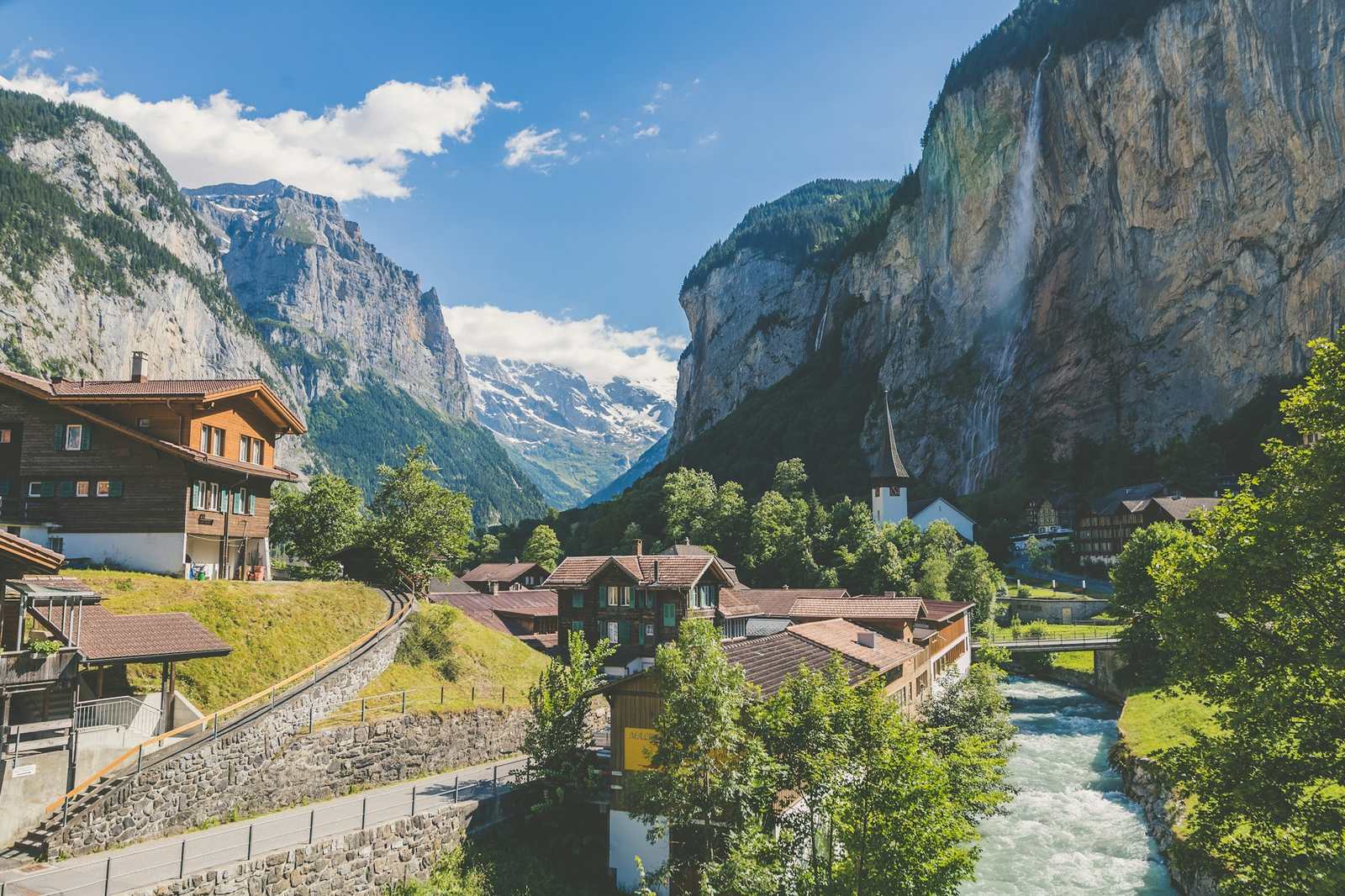
In 2026, Switzerland remains one of the relocation destinations most often considered by families and professionals who want a safe setting, remarkable landscapes, solid schools and a highly predictable daily organisation — at the price of a high cost of living and a framed right of residence and of buying property. People come first for the way of life, the chosen canton and the school; tax, which differs sharply from one canton to another, comes next.
This guide distinguishes Geneva, Lausanne and La Côte, Zurich, Basel, Zug and Ticino, sets out the official figures from the French consular register, and describes the Lex Koller, LAMal and tax framework, without inventing a price per square metre. For a detailed purchase walk-through in another European country, see also our article on buying in Portugal.
Lifestyle and everyday life
Switzerland is not a single daily life. French predominates in Geneva, in the canton of Vaud and in Valais; German (and Swiss German) in Zurich, Basel, Bern and most of the country; Italian in Ticino. This linguistic geography shapes school, work and the social circle. Transport is dense, landscapes are close, public services are of a high standard. The other side, well known, is cost: housing, restaurants, health insurance, childcare.
The pace is calmer than that of a large Latin capital, with a marked respect for rules, timetables and neighbours. The lakes (Geneva, Zurich, Lucerne, Maggiore) and the Alps are a real weekend setting, not just a postcard. Many families combine a job in a hub (Geneva, Zurich, Basel, Lausanne) with a home in a more residential commune, sometimes across a cantonal border — which has consequences for tax and for school.
For a family coming from France, Geneva and the canton of Vaud offer the most obvious linguistic continuity, and a French-curriculum school offer. Zurich attracts for employment and a different cultural world. Ticino appeals for the climate and Italian. The right choice starts from the purpose (work, school, language, proximity to France or to the United Kingdom by air) more than from an abstract ranking.
Where to live: Geneva, Lausanne, Zurich, Ticino
Geneva and the shore
Geneva concentrates international organisations, an already large French-speaking community, the lycée and other schools, and a particularly tight property market. Champel, Florissant, Eaux-Vives, the shores and certain communes in the canton (Cologny, Vandoeuvres, or more modest communes) offer very different daily lives. Living on the French side (Annemasse, Ferney, Pays de Gex) is a cost option, common for cross-border workers: it is not Swiss residence, and a cross-border-worker status is not that of a resident. That distinction must stay clear, for tax and for the permit.
Lausanne, Nyon, La Côte
Lausanne and the Vaud shoreline (Nyon, Rolle, Morges) attract families who want Lake Geneva, a school fabric, and a slightly less “international-organisation” pace than Geneva. The French school or AEFE-network establishments in the canton, international schools and the Vaud public system make up a broad offer. Journey times to Geneva, by train, are a concrete criterion.
Zurich, Winterthur and Zug
Zurich is the main German-speaking economic hub: Seefeld, Enge, the Zürichberg, communes on the lake and Winterthur offer very distinct kinds of housing. The everyday language is Swiss German; English is common in international circles, insufficient for officialdom and state school. Zug, nearby, is often cited for its cantonal tax: a plan to live in Zug should be judged on the job, the school, the actual home and the permit rules, not on a tax slogan.
Basel, Bern, Valais, Ticino
Basel, on the French and German borders, has a dense pharmaceutical and cultural fabric, and a French lycée in the AEFE network. Bern offers a more administrative, residential setting. Valais (Sion, Sierre, the resorts) combines French, mountains and a sometimes more seasonal market. Ticino (Lugano, Locarno, Ascona) offers an Italian daily life, a milder climate and another relationship with northern Italy. In all these cantons, the permit, the school and the home hold together.
Advantages and points to watch
Advantages
- A high quality of life, landscapes, safety and infrastructure among the strongest in Europe.
- Four languages, French-curriculum schools (AEFE network) and many international schools.
- A high-quality health system (compulsory LAMal health insurance).
- A demanding but, depending on the permit, open labour market in several hubs (Geneva, Zurich, Basel, Lausanne).
- Institutional stability and a predictable legal framework, canton by canton.
Points to watch
- A cost of living and of housing among the highest in Europe, with large differences between cantons.
- Lex Koller frames property purchases by persons abroad; it is not an open market without conditions.
- Residence permits: British nationals, since Brexit, no longer benefit from EU free movement.
- Compulsory health insurance carries high premiums, which vary by canton and deductible.
- Taxation (federal, cantonal, communal, and wealth tax) is complex and highly local.
Property: official indices, no listing averages
This page does not publish an “average price per square metre” drawn from property portals. The Federal Statistical Office (FSO) publishes residential property price indices, which measure a change over time, for different categories of property. Consult the FSO’s latest official release for the current pace; a local professional remains essential for a specific home. Gaps between central Geneva or Zurich, a mid-sized town and a mountain commune are considerable.
Purchases by a person abroad are framed by the Federal Act on the Acquisition of Real Estate by Persons Abroad, known as Lex Koller. The conditions depend on the residence permit, the use of the property (especially as a primary residence) and, sometimes, the canton and the type of commune (tourist areas, caps). A resident holding certain permits may, subject to conditions, buy the home they occupy; a non-resident is in a much more constrained position, often subject to authorisation, or even excluded. A Swiss notary should examine the case before any promise.
Acquisition costs (duties, notary, any commission) vary by canton. The rental market, under strong demand in the hubs, has its own tenant-protection rules. In every case, housing comes before the tax slogan: an attractive lump-sum or scale does not justify a purchase that Lex Koller does not allow, or a rent that the budget cannot support once LAMal premiums are added.
Schools and family life
The AEFE network is present in Switzerland, including the Lycée français Marie-Curie in Zurich and schools in Geneva, Lausanne, Basel and Bern, among others. Admissions, fees and places should be checked with each school and with AEFE. This page does not publish pupil numbers. There are also international schools, bilingual private schools and the cantonal public system, of a high standard, in the language of the region.
The school calendar, the language of instruction and commuting time are the three variables that, in practice, decide the home. A French-speaking family in Zurich does not have the same options as in Lausanne. Nurseries and after-school care are of good quality, costly, and sometimes subject to waiting lists. It is wise to open the files a year ahead.
How many French nationals in Switzerland?
At 1 January 2025, the register of French nationals established outside France recorded 168,881 enrolments in Switzerland. It is, by some distance, one of the very largest French communities abroad. The same register recorded 187,232 in 2017, 169,166 in 2023 and 172,313 in 2024. The series is not monotonic: a long-term decline, with ups and downs. Registration is voluntary; these official counts understate the actual community, which also includes dual nationals and people who are not registered.
The Federal Statistical Office publishes a permanent-resident statistic by nationality, a different concept (residents, not voluntary consular enrolments). This page does not repeat an FSO headcount that has not been verified in an official publication consulted for this guide.
Registration on the register of French nationals established outside France is voluntary. These official counts therefore understate the actual community. Source: French Foreign Ministry, community CSV files, registrations at 1 January.
Residency, formalities and healthcare
EU and EFTA citizens fall under a free-movement agreement regime, with permits (notably a B permit) and, depending on the case, quotas or employment conditions. Formalities go through the canton and the State Secretariat for Migration (SEM). An employment contract, a home and health insurance are, in practice, the foundation.
British nationals, since Brexit, no longer benefit from that free-movement regime. A permit must be obtained under Swiss law and any agreements in force between the United Kingdom and Switzerland. The official rules are those of the SEM, to be read at the date of your plans, not an old summary.
Basic health insurance (LAMal) is compulsory, in principle within three months of arrival. Basic benefits are set by law; premiums vary by canton, insurer and deductible. Complementary cover is common. It is a high budget item, to be costed before comparing a “Swiss” salary with a French or British one. The care system is of excellent quality, with patient participation (deductible, co-payment).
Tax in 2026 — what is useful to know next
Swiss tax is federal, cantonal and communal. Income tax, personal wealth tax, and the scales vary sharply from one canton — and sometimes one commune — to another. A plan “in Switzerland” without a choice of canton has no tax content. The treaties (France–Switzerland, United Kingdom–Switzerland) frame tax residence and the elimination of double taxation, including on pensions, salaries from international organisations and property income.
Expenditure-based taxation (often called a “lump-sum” or “forfait”) still exists in some cantons, under conditions of federal and cantonal law, mainly for foreign nationals without a gainful activity in Switzerland. Several cantons have abolished it. The conditions, the calculation and the legal minimum should be checked in the canton you have in mind, with an adviser. It is neither an automatic right nor a single amount valid for the whole country.
If you leave France, the French exit tax on certain unrealised gains may apply. A departure outside the European Union does not, in principle, benefit from the automatic deferral available within the EU: guarantees or other conditions may be required. The impots.gouv.fr page (updated on 10 March 2026) is the starting point; a proposal to extend the period to fifteen years is not in force. Have your position reviewed by an adviser.
As elsewhere, the order of decisions matters: the canton, the permit, the home and the school first; tax next, in light of your nationality and your activity. A slogan about “the lump-sum” or “Zug” does not replace that sequence.
Frequently asked questions
How many French nationals live in Switzerland?
At 1 January 2025, the French Foreign Ministry’s voluntary register recorded 168,881 enrolments in Switzerland, after 172,313 a year earlier and 187,232 in 2017. Registration is voluntary: these counts understate the actual community. The Federal Statistical Office also publishes permanent-resident statistics by nationality, which measure something else; this page does not repeat an FSO figure unless it has been verified in an official publication consulted for this guide, which is not the case here.
Can I buy a home in Switzerland if I come from abroad?
The Federal Act on the Acquisition of Real Estate by Persons Abroad, known as Lex Koller, frames these purchases. The conditions depend in particular on the residence permit, the use (primary residence or not) and the canton. A resident holding certain permits may, subject to conditions, buy their home; a non-resident is in a much more constrained position. Have the specific case reviewed by a Swiss notary. This page does not replace that advice.
What is the average price per square metre?
This page does not publish listing-website averages. The Federal Statistical Office publishes residential property price indices, which measure a change, not an average price in Swiss francs per square metre for a given city. Consult the FSO’s latest official release for the current pace of prices, and a local professional for a specific property. Gaps between Geneva, Zurich, mid-sized towns and the mountains are considerable.
How does health insurance work?
Anyone settling in Switzerland must, in principle, take out insurance with a LAMal insurer within three months. Basic insurance is compulsory, benefits are set by law, and premiums vary by canton, insurer and the deductible chosen. Complementary insurance is common. It is a significant budget item, to be planned before arrival.
What is lump-sum taxation (expenditure-based taxation)?
Some cantons still offer, under conditions set by federal and cantonal law, taxation on the basis of expenditure, often called a “lump-sum” or “forfait”. It is aimed mainly at foreign nationals who do not carry on a gainful activity in Switzerland. Several cantons have abolished it. The conditions, the calculation and the applicable minimum should be checked in the canton you have in mind, with an adviser, and cannot be reduced to a single figure.
Do British nationals have the same residence rights as EU citizens?
No. Since Brexit, British nationals no longer benefit from the free movement provided for EU and EFTA citizens. A permit must be obtained under Swiss law and any agreements in force between the United Kingdom and Switzerland. The State Secretariat for Migration (SEM) publishes the applicable rules. They should be read at the date of your plans.
Are you thinking of moving to Switzerland?
Leave your details and we can talk through the practical side of your plans — canton, housing, schools, formalities. A personal conversation, with no obligation.