
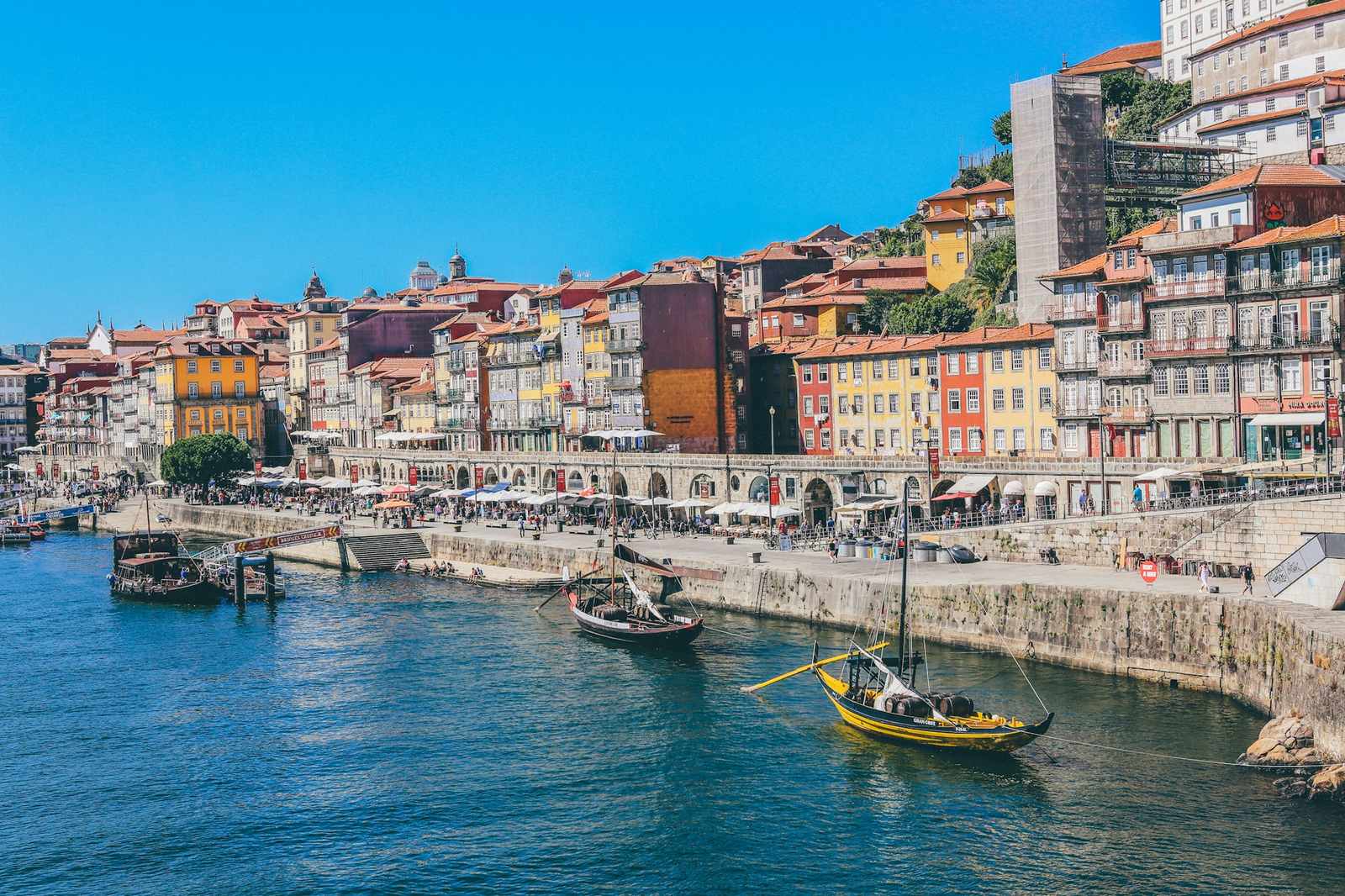
Portugal remains, in 2026, one of the most frequently considered moves for British families, retirees and professionally mobile households who want a change of pace without leaving Europe far behind. People come first for the climate, the sea, a daily life that still feels more straightforward than London, and a property market that looks very different in Lisbon, Cascais, Porto or the Algarve. Tax questions — the closure of the NHR regime to new arrivals, ordinary IRS rates, and, for anyone who has been tax-resident in France, exit tax — come afterwards, once the neighbourhood, the school and the housing budget are a little clearer.
This guide covers lifestyle, the official property market (Statistics Portugal, second quarter 2026), purchase costs, schools and residency formalities. A companion article, Buying property in Portugal in 2026, walks through a purchase in more detail.
Lifestyle and everyday life
Climate is usually the first reason given: mild winters in Lisbon, abundant light in the Algarve, a greener and wetter north around Porto. The sea shapes many housing choices, from Cascais to Lagos. Flights to London, Manchester, Paris and Geneva are frequent; the Alfa Pendular train links Lisbon and Porto in a little over three hours.
Day-to-day safety is generally regarded as good. Portuguese is the language of administration and of neighbourhood life; English is widely used in Lisbon, Cascais and the Algarve, particularly in services and international schools. Learning some Portuguese is not a precondition for moving, but it makes appointments, healthcare and settling in noticeably easier.
On healthcare, residents register with the Serviço Nacional de Saúde (SNS) and receive a número de utente. Hospital provision is fuller in the larger cities. Many families take out private insurance as well, especially while SNS registration is being completed. A UK Global Health Insurance Card can help with medically necessary care on a temporary stay; it is not a substitute for cover once you live in Portugal. After Brexit, long-term healthcare arrangements should be checked with a professional before you rely on them.
Where to live: Lisbon, Cascais, Porto, the Algarve
The “right” area depends less on a ranking than on schools, the pace of life you want, and a housing budget that varies sharply from one municipality to the next.
Lisbon
A lively, hilly capital, still very walkable in many districts. Estrela, Campo de Ourique, Lapa and Príncipe Real appeal to people who want neighbourhood life; Parque das Nações, a newer area, attracts families for its space and connections. The historic centre (Chiado, Baixa, Alfama) is dense and heavily touristed. The rental market is tight, and purchase prices in the municipality are the highest in the country (see below).
Cascais, Estoril and Oeiras
The coast west of Lisbon has long been a favoured choice for international families: the sea, a promenade, schools, and a commuter train into central Lisbon. It is also one of the most expensive markets. In the second quarter of 2026, Cascais and Oeiras ranked just behind Lisbon among the municipalities with the highest median prices, according to INE.
Porto and its metropolitan area
Porto offers a much-liked way of life (Foz, Matosinhos, the historic centre), median prices clearly below Greater Lisbon, and a full-curriculum French lycée. The city feels more compact, rain is more frequent, and the rhythm is a little less “capital”.
The Algarve
Sun, golf, the sea, a long-established British community, and a marked seasonal pattern — busy summers, quieter winters. Faro airport serves the region. A practical point for families seeking a French-curriculum school: AEFE-accredited lycées in Portugal are in Lisbon and Porto; in the Algarve the offer is mainly English-medium international or Portuguese schools. Check the AEFE directory and individual school sites before you settle on an area. British-curriculum and IB schools are part of the landscape along this coast and in the Lisbon–Cascais corridor.
Advantages
- Pleasant climate and easy access to the sea, especially in the south and at Cascais
- Frequent flights to the UK and the rest of Europe
- A well-established British community, particularly in the Algarve
- International, British-curriculum and IB schools, plus French lycées in Lisbon and Porto
- A cost of living that is still more moderate outside the most sought-after addresses
- Relatively straightforward day-to-day life once residency is in place
Points to watch
- Sharp property-price increases in Lisbon, Cascais and the Algarve
- Bureaucracy that can be slow (residency, land registry, building work)
- NHR closed to new arrivals; ordinary tax rules need to be planned for
- A tight rental market in the main cities
- No AEFE French lycée in the Algarve
- Seasonal tourism on the southern coast
Property: official prices in 2026
Statistics Portugal (INE) publishes median prices per square metre from transactions recorded by the tax authority — not asking prices. In the second quarter of 2026:
| Area | Median price (€/m²) |
|---|---|
| Municipality of Lisbon | 5,299 |
| Cascais | 5,200 |
| Oeiras | 4,704 |
| Greater Lisbon (NUTS III) | 4,030 |
| Algarve | 3,500 |
| Porto metropolitan area | 2,669 |
| Portugal as a whole | 2,445 |
Source: INE, local housing-price statistics, second quarter 2026 (median of family-dwelling transactions). Lisbon, Cascais and Oeiras were the three municipalities with more than 100,000 residents that posted the highest median prices.
Year on year, the national median rose 18.4% (after 19.8% in the previous quarter). The House Price Index (IPHab) rose 16.5% year on year. The number of transactions fell (about −9% for family dwellings in the local-price release, −6.4% in the IPHab release — the two publications do not cover exactly the same field). Prices are still rising at a high rate, while the volume of deals has contracted. In Lisbon municipality, the year-on-year rate of increase slowed markedly from the previous quarter (a drop of 8.9 percentage points in that rate, still according to INE).
If you are buying from abroad, another official fact is worth noting: in Greater Lisbon, the median price of transactions by a buyer with a tax domicile outside Portugal was 47% higher than for buyers tax-domiciled in Portugal (37.5% in the Porto metropolitan area). In the second quarter of 2026, 1,890 dwellings were bought by a purchaser with a tax domicile outside the country, down 10.3% year on year (IPHab publication).
Buying a home: process and costs
Once a property has been identified with a local professional, the usual path includes obtaining a NIF (tax number), documentary due diligence (land registry, licences, condominium charges, planning status — especially for older buildings or rustic land), a promissory contract (CPCV) often accompanied by a deposit, payment of IMT and stamp duty before completion, then the escritura before a notary and registration at the Conservatória. A lawyer or solicitador independent of the seller is strongly advisable.
Two purchase taxes should be budgeted for:
- IMT (municipal property-transfer tax), on an official scale that depends on whether the home is a primary residence and, since May 2026, on whether the buyer is resident;
- Imposto do Selo (stamp duty) at 0.8% of the same base as IMT (Portal das Finanças).
For a primary and permanent home on the mainland, the 2026 scale provides an exemption up to €106,346, then marginal rates of 2%, 5%, 7% and 8%, a single 6% rate between €660,982 and €1,150,853, and 7.5% above that (Article 17 of the IMT Code, bands updated by Law No. 73-A/2025 of 30 December). A home that is not a primary residence follows a slightly less favourable scale from the first euro (a 1% rate on the first band).
A 2026 change that matters if you buy before you move. Decree-Law No. 97/2026 of 20 May 2026 added a new paragraph 10 to Article 17: when a non-resident buys a residential property, the rate is in principle a flat 7.5%, with no exemption or reduction. The main exceptions: the buyer has already been treated as a Portuguese tax resident; they become one within two years of the purchase; or the property is let for housing, within the rent caps set by the decree, within six months, for at least 36 months in the first five years. In the last two cases you may apply to the tax authority, within six months, for cancellation of the difference between the 7.5% paid and the ordinary scale.
Illustrative example only (official scales, rounded to the euro, excluding notary, agency and any works). A flat at €530,000 — a rough order of magnitude for about 100 m² at Lisbon city’s median price in Q2 2026; the actual price depends heavily on the neighbourhood. As a primary residence on the mainland resident scale: IMT of about €28,637 (8% less the official deductible of €13,763.35) plus stamp duty of €4,240, or nearly €32,900 in acquisition taxes. As a non-resident at 7.5%: IMT of €39,750 plus €4,240, or about €44,000. The IMT gap (about €11,100) may, subject to conditions, be reclaimed if the buyer becomes a tax resident within two years. Have your own case figured by a professional: “primary residence” status and residence itself have a direct effect.
Once you own the property, an annual municipal tax (IMI) applies to the taxable patrimonial value, at a rate set by each municipality. Other charges may apply in some cases; a local adviser will identify them more reliably than a general guide.
The purchase path, documentary pitfalls and the 7.5% rate are discussed more fully in Buying property in Portugal in 2026.
Schools and family life
Families looking for a French curriculum have two AEFE-accredited schools covering nursery through to the French baccalauréat: the Lycée français Charles-Lepierre in Lisbon (2,074 pupils according to the AEFE directory) and the Lycée français international de Porto. Charles-Lepierre, which is directly managed by the AEFE, notes that places are limited and that new admissions for 2026–27 go through a panel. Tuition fees are published each year by the schools: check their websites, as the figures change.
International, British-curriculum and IB schools operate in the Lisbon–Cascais corridor, in Porto and in the Algarve. Portuguese state schools are an option, especially for younger children if language is not a barrier. In every case it is wise to start applications before you sign a lease or a promissory contract: the school often determines the neighbourhood, not the other way around.
The international community
The Algarve has been home to a large, long-established British community for decades; Lisbon, Cascais and Porto also have sizable international populations, including French-speaking families. The UK authorities do not publish a comparable, up-to-date official headcount of British nationals by country of residence in the same way, so this page does not quote a figure for Britons in Portugal.
For context, the French consular register — which is voluntary, and therefore an under-count — recorded 21,023 French registrations in Portugal on 1 January 2025 (French Foreign Ministry official CSV). The community is concentrated around Lisbon and Cascais, in the Algarve and in Porto, and is organised enough (schools, associations) to make arrival easier, without forcing anyone to live in an enclave.
Residency and practical formalities
EU citizens enjoy freedom of movement and, after three months, register for an EU-citizen registration certificate. A NIF, a bank account and, where relevant, SNS registration are among the first practical steps.
For British nationals, a residence title is required. Common routes include the D7 visa (passive income or retirement, subject to means), visas for work or “digital nomads”, family reunification, and the Golden Visa (residence permit for investment, Article 90-A). Direct real estate is no longer an eligible Golden Visa route; qualifying investment routes remain, on the terms published by AIMA. Criteria, time limits and amounts change: rely only on the official text and on an immigration lawyer.
Tax in 2026 — what is useful to know next
You generally become a Portuguese tax resident by spending 183 days in the country, or by having your habitual home there — the exact tests are in Article 16 of the IRS Code. A resident is taxed on worldwide income, subject to tax treaties (Portugal has one with the United Kingdom, and one with France).
The NHR (non-habitual resident) regime has been closed to new arrivals since 1 January 2024, with transitional provisions in some situations. People already admitted keep the benefit until the end of their ten-year period.
A narrower regime, IFICI (the Tax Incentive for Scientific Research and Innovation, sometimes called NHR 2.0), is for people who become resident, were not Portuguese residents in any of the previous five years, have not benefited from NHR, and carry on an eligible activity (research, higher-education teaching, highly qualified professions under the applicable ministerial order, and so on). For ten years, a special 20% rate applies to net employment or self-employment income (categories A and B) from those activities in Portugal. Most foreign income is in principle exempt — not foreign pensions, nor certain income paid from a clearly more favourable tax jurisdiction (a 35% rate in that case). This is not a general “wealth or retirement” regime: without an eligible activity, ordinary rules apply.
Under ordinary rules, for 2026, resident IRS is progressive from 12.5% to 48%, plus a solidarity surcharge of 2.5% above €80,000 of taxable income and 5% above €250,000 (PwC Tax Summaries, reviewed 3 October 2026). Dividends and interest are in principle taxed at a flat 28% (with an option to aggregate). Gains on securities are generally at 28%, with, for certain listed securities or fund units, a partial exclusion of 10%, 20% or 30% where the holding exceeds two, five or eight years — and mandatory aggregation in some cases (held for less than 365 days and taxable income of at least €86,634). Rental income has its own rates. All of this needs to be declared, treaty-planned and anticipated with a tax adviser: the figures above are official or recognised-summary orders of magnitude, not a personal computation.
Leaving the United Kingdom is a separate question from becoming resident in Portugal. UK tax residence follows the statutory residence test. Since 6 April 2025 the former non-dom regime has been replaced by the Foreign Income and Gains (FIG) rules for qualifying new UK residents (a four-year regime, after at least ten consecutive years of non-UK residence, claimed annually — HMRC). If you are leaving the UK, income tax, capital gains and inheritance tax consequences depend on your residence history and should be reviewed with a UK adviser, in parallel with a Portuguese one.
If you have also been a French tax resident (at least six of the previous ten years) and your shareholdings reach the legal thresholds, France’s exit tax (Article 167 bis of the CGI) may apply. Because Portugal is in the EU, payment deferral is in principle automatic, subject to conditions; relief after two or five years of holding may follow (impots.gouv.fr, updated 10 March 2026). This is not personal advice.
More generally, a change of residence is the moment to review, with a qualified professional, how your wealth is held (accounts, insurance contracts, property in the UK or France and in Portugal) so that it still fits a life in two countries. That is not the purpose of this guide, and there is no off-the-shelf scheme.
Frequently asked questions
Do I need to speak Portuguese to live in Portugal?
English is widely used in Lisbon, Cascais and the Algarve, especially in services and international schools. For public administration, healthcare and neighbourhood life, even basic Portuguese makes a clear difference. It is not a prerequisite for moving, but it is a genuine advantage.
Where should a family settle in Portugal?
Many families look at Lisbon and the Cascais–Oeiras coast, where there is a French lycée and several international and British-curriculum schools, or at Porto (which also has a full-curriculum French lycée). In the Algarve the school offer is mainly English-medium international or Portuguese state schools; there is no AEFE-accredited French lycée on the southern coast.
What are Lisbon property prices in 2026?
In the second quarter of 2026, Statistics Portugal (INE) reported a median transaction price of €5,299 per square metre in the municipality of Lisbon, €5,200 in Cascais and €4,030 in the Greater Lisbon sub-region. The national median was €2,445/m². These are medians of recorded sales, not asking prices, and a given home can sit well above or below them.
Do non-residents pay a higher property transfer tax (IMT)?
In principle, yes. Under Decree-Law No. 97/2026 of 20 May 2026, a non-resident buying a residential property is generally charged a flat 7.5% IMT rate, with no exemption or reduction. Exceptions include already being a Portuguese tax resident, becoming one within two years of the purchase, or letting the property for housing on specified terms. In the last two cases you may apply for a refund of the difference.
Can I still get a Portugal Golden Visa by buying a home?
No. Direct real-estate investment is no longer an eligible route. AIMA still lists other qualifying investment routes (including funds that meet legal criteria). Always check the current official conditions and take immigration-law advice before committing.
Does the NHR tax regime still exist?
It has been closed to new arrivals since 1 January 2024, subject to transitional rules in some cases. People already admitted keep the benefit until the end of their ten-year period. A narrower regime, IFICI (sometimes called NHR 2.0), is available to qualifying professionals in eligible activities, with a 20% rate on certain Portuguese employment and self-employment income and exemptions on most foreign income — but not on foreign pensions.
Are you thinking of moving to Portugal?
Leave your details and we can talk through the practical side of your plans — area, housing, schools, formalities. A personal conversation, with no obligation.