
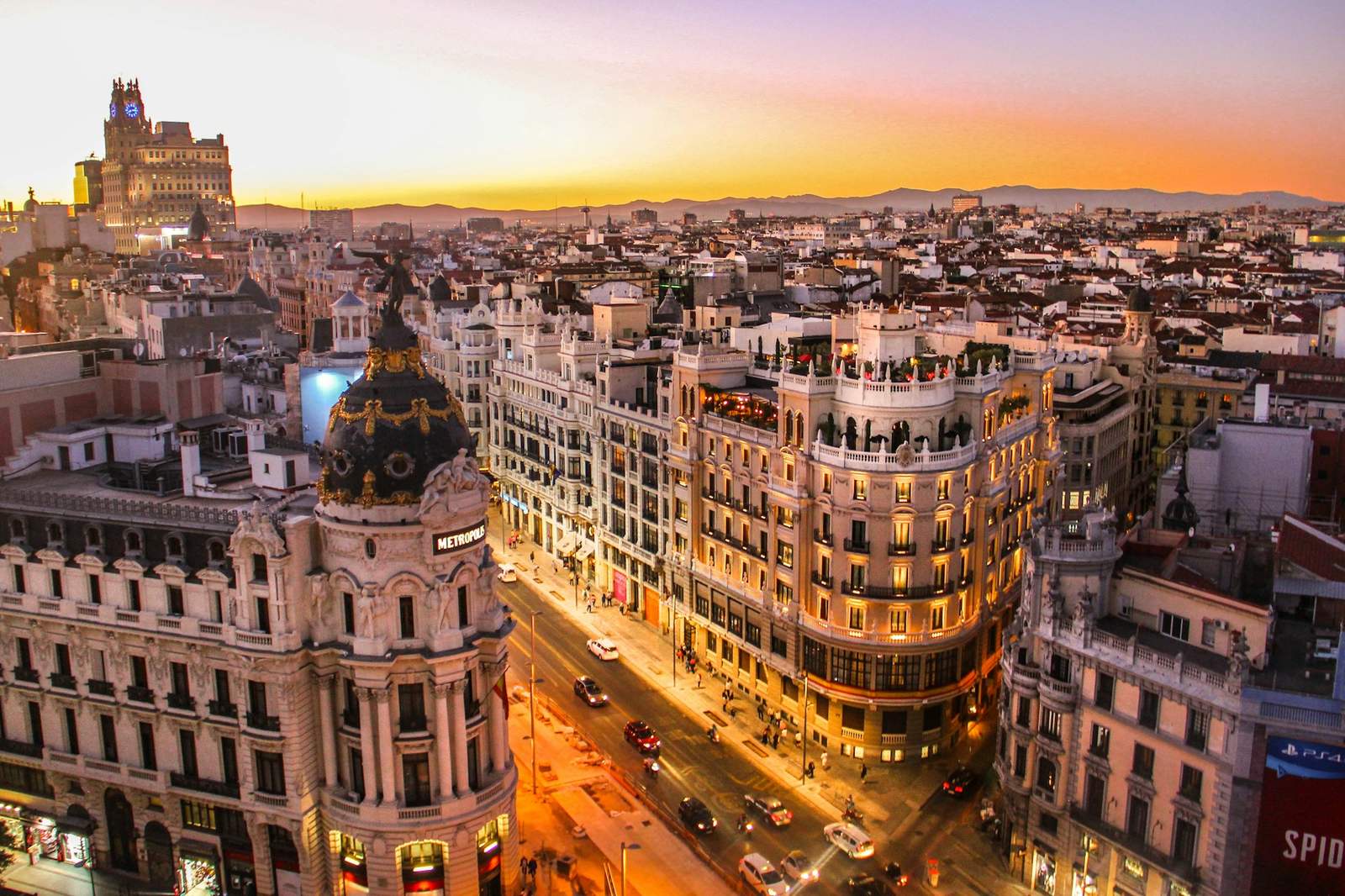
In 2026, Madrid attracts families and professionals who want a full, sunny European capital, still relatively more approachable than Paris or London, and well connected to the rest of the continent. People come first for the way of life — terraces, museums, parks, distinctive neighbourhoods — for the schools, and for a property market that is in high demand. Tax questions — the Spanish income-tax scale, the inbound-workers regime, wealth tax at regional level, the French exit tax — come next, once the area and the school are a little clearer.
This guide covers lifestyle, neighbourhoods, official property figures, schools, formalities and, as a second layer, tax. For a detailed walk-through of a purchase in another European country, you may also want our article on buying a home in Portugal.
Lifestyle and everyday life
Madrid sits on a plateau, more than 600 metres above sea level, with short, dry winters and very hot summers. The historic centre — between Plaza Mayor, the Royal Palace, the museums of the Paseo del Prado and Retiro Park — is walkable. Around it, the residential districts each have their own character: Chamberí’s handsome blocks, Salamanca’s avenues, the houses of El Viso, the greener western suburbs.
Everyday life is urban and late: dinner is later than in Paris, terraces stay busy, and the cultural calendar (the Prado, Reina Sofía, Thyssen, theatres, football) is that of a major capital. The metro, EMT buses and Cercanías commuter trains cover a large metropolitan area. Barajas links Madrid to Europe in around two hours and has a particularly dense network to Latin America. The language of officialdom and of most public medical practices is Spanish; English helps in international schools and some services, but it is not enough on its own.
The cost of living, excluding housing, is generally still lower than in Paris or Zurich, but the gap has narrowed. Housing itself has become markedly more expensive: that is the point official INE figures document most clearly.
Where to live: Salamanca, Chamberí, the north and the west
Salamanca and Recoletos
The Salamanca district, around Serrano, Recoletos and Plaza de Colón, remains Madrid’s most emblematic “prime” address. Handsome buildings, shops, proximity to the Retiro and the museums: you pay for centrality. Goya, Lista and the streets towards Parque de las Avenidas can offer a little more space, depending on the street. It is a tight market, in which the quality of the building and the floor makes a large difference.
Chamberí, Justicia and around Alonso Martínez
Chamberí suits many families who want to remain inside the city proper, with residential streets, local schools and a direct route into the centre. Trafalgar, Almagro, Gaztambide and Plaza de Olavide each have their own pace. Just to the east, Justicia and Chueca are more urban and livelier in the evening, sometimes less suitable for very young children depending on the building, but excellent for a pied-à-terre.
Chamartín, El Viso and the north
Further north, Chamartín, El Viso, Nueva España and the Paseo de la Castellana corridor offer more family-sized homes, sometimes with a garden or in quieter developments. Chamartín station and connections to northern Spain are an advantage. It is also an office corridor: the daily commute depends heavily on the exact address.
Retiro, Los Jerónimos and the inner south-east
Around Retiro Park and towards Los Jerónimos, you gain the quiet of the park and proximity to the museums, in a mainly residential fabric. Further south and east (southern Retiro, Pacífico, Estrella), prices are generally lower than in Salamanca, with decent metro access. You need to visit building by building: construction quality varies.
Pozuelo, Majadahonda, Las Rozas, La Moraleja
Many families, especially those aiming for the Lycée français de Madrid or international schools in the west, settle in the surrounding municipalities: Pozuelo de Alarcón, Majadahonda, Las Rozas de Madrid, or around La Moraleja (Alcobendas). There you find houses and apartments with more space, school campuses, and a more car-dependent daily life. Journey times into central Madrid should be measured at peak hours, both by car and on the Cercanías.
Other options exist: the historic centre (Palacio, Ópera) for a very urban lifestyle; Usera or Lavapiés for a more mixed, popular Madrid, if you accept a different environment; Aravaca and Puerta de Hierro on the city’s edge. The right choice almost always starts from the school and the commute, not from an abstract ranking of neighbourhoods.
Advantages and points to watch
Advantages
- Sunny continental climate, a dense cultural life and a walkable historic centre.
- A major air hub (Barajas) towards Europe, Latin America and Africa, plus a high-speed rail network.
- A French lycée (Lycée français de Madrid) and a wide choice of international and British-curriculum schools.
- A solid public health system (SNS), complemented by widely used private care.
- For EU citizens, freedom of movement and residence.
Points to watch
- A tight property market, with annual price growth still strong according to INE.
- Very hot summers in the centre; air-conditioning and the choice of neighbourhood matter.
- Spanish is essential for public administration, public healthcare and everyday neighbourhood life.
- Traffic and pollution on some corridors; the metro and Cercanías largely make up for it.
- Personal taxation (income tax, and wealth tax depending on the region) needs to be planned in advance.
Property: official indices in 2025 and 2026
This page does not repeat “average prices per square metre” from listing websites: those are not official statistics, and they mix very different properties. Spain’s National Statistics Institute (INE) publishes the House Price Index (IPV), which measures the change in transaction prices of free-market homes, new and second-hand, for Spain and for each autonomous community.
According to INE’s press release for the second quarter of 2026 (final data, 2025 base), the annual change in the national IPV stands at 12.2%. New housing is up 7.4% year on year, second-hand housing 12.9%. Compared with the previous quarter, the general index rises by 3.4%. Every autonomous community and autonomous city shows a positive annual rate, ranging, for this quarter, from 9.5% (Navarre) to 15.2% (Ceuta).
For the Community of Madrid alone, official INE table no. 25171 (the series available to the fourth quarter of 2025 in the file downloaded in 2026) shows an annual change of 14.2% in the fourth quarter of 2025, for the general index (14.5% for second-hand, 12.3% for new). The quarterly change in 2025-Q4 was 1.8%. These figures describe a rise, not a price level in euro: the IPV does not publish an average price per square metre.
The ministry responsible for Housing also publishes appraisal-value (valor tasado) statistics that can provide an official order of magnitude in euro per square metre, by region and sometimes by municipality: you should read the latest bulletin, with its date, rather than rely on a listings average. In any event, the price of a flat in Salamanca has nothing in common with a comparable home in Vallecas or Majadahonda: the neighbourhood, the floor, the condition and the quality of the building come first.
Buying a home: process and costs
A purchase in Madrid follows Spanish law: a NIE (foreigner’s identification number) for the buyer, a private contract or deposit agreement (contrato de arras), a notarial deed (escritura), registration at the Registro de la Propiedad, and settlement of taxes and fees. A local lawyer, independent of the agency, and a check of the property’s cadastral, mortgage and planning position are good practice, including for a private sale.
Purchase costs typically include: transfer tax (ITP, Impuesto sobre Transmisiones Patrimoniales) on second-hand homes, or VAT and stamp duty (AJD) on new builds, at rates set by the autonomous community and subject to change; notary and land-registry fees; and possibly agency fees, depending on who is liable. The exact rates applicable in the Community of Madrid should be checked on the official Comunidad and Agencia Tributaria pages, at the date of your plans. This page is not a personalised cost estimate.
Non-residents may buy. A Spanish bank account makes it easier to pay service charges and local property tax (IBI). The rental market, under strong demand in the centre, is framed by national legislation and, where relevant, regional measures: read the rules in force before counting on a yield.
Schools and family life
The Lycée français de Madrid, a school in the AEFE network, is the anchor for many French-speaking families. It has several sites in the west of the metropolitan area; admissions, fees and any waiting lists should be checked directly with the school and with AEFE. This page does not publish a pupil headcount, because no official figure is cited here.
There are also international and British-curriculum schools, Spanish bilingual schools, and the Community of Madrid’s public and publicly funded private (concertado) network. The calendar (a September start, long summer holidays) and the language of instruction should be planned a year ahead, especially for a French lycée or a sought-after international school. For younger children, escuelas infantiles and private nurseries complete the offer, with strong demand in some neighbourhoods.
Family life in Madrid also rests on the parks (Retiro, Casa de Campo, Madrid Río), sports clubs and a long-established French-speaking community. The school run and commuting weigh more than in a smaller city: the school-and-home pair is the structural decision.
How many French nationals in Spain — and in Madrid?
At 1 January 2025, the register of French nationals established outside France recorded 85,201 registrations in Spain, after 82,337 a year earlier and a low of 78,721 in 2021. In 2017, the same register recorded 85,121. Madrid is one of the main hubs of that community — together with Barcelona and the coasts — but the French Foreign Ministry does not publish, in its country-level community files, a separate total for the Community of Madrid alone. Regional ranges sometimes quoted elsewhere are not repeated here, because no dedicated official source is available.
Registration is voluntary: these official counts understate the actual community. They remain, however, the public reference series.
Registration on the register of French nationals established outside France is voluntary. These official counts therefore understate the actual community. Source: French Foreign Ministry, community CSV files, registrations at 1 January.
Residency, formalities and healthcare
EU, EEA and Swiss citizens who settle for more than three months apply for a Union-citizen registration certificate and a NIE, from the police or the competent immigration office. It is a formality, not a visa, but it is needed for many steps (work, school, healthcare, banking). Non-EU family members follow a separate procedure.
British nationals, since Brexit, no longer have EU freedom of movement. Depending on the purpose (employment, non-lucrative residence, a remote-work visa, family reunification), a visa and a residence permit are required, with conditions on means, insurance and, where relevant, investment or activity. Official rules are on the website of the Ministry of Inclusion, Social Security and Migration, and at consulates. They change: do not rely on an old summary.
Healthcare rests on the Sistema Nacional de Salud (SNS), available to residents who affiliate (employment, a retirement S1 form from an EU State, or another qualifying title). Many families add private insurance, in particular to choose their doctor and shorten waits in some specialties. The Spanish social-security number and a family doctor (médico de cabecera) are arranged after arrival. Until then, the European Health Insurance Card covers necessary care during a temporary stay, not a relocation.
Tax in 2026 — what is useful to know next
Once the neighbourhood, the school and the home are clearer, tax becomes the second subject. Spanish tax residents are in principle taxed under personal income tax (IRPF) on their worldwide income, on a state scale plus a regional share. The Community of Madrid has, for several years, run its own tax policy (scales, deductions, treatment of wealth tax) that can differ markedly from other regions: the measures in force should be read in the regional legislation and on the Agencia Tributaria website, at the date of your move, not in a frozen summary.
The special regime for inbound workers (article 93 of the IRPF law, often called the “Beckham law”) can, subject to conditions on prior non-residence, the type of activity and a formal election, allow particular taxation of Spanish employment income for a limited number of tax periods. The regime has been amended several times. The conditions, rate and duration applicable in 2026 are on the Agencia Tributaria website; this page does not replace them.
Wealth tax (Impuesto sobre el Patrimonio) and, where relevant, the solidarity tax on large fortunes, sit in a national framework with regional application. The Community of Madrid has historically granted a large rebate on wealth tax: check the law in force for the year in question, including any effects of the solidarity tax. The tax treaties (France–Spain, United Kingdom–Spain) remain the framework for avoiding double taxation, including on pensions, property income and capital gains.
If you leave France, the French exit tax on certain unrealised gains may apply. For a departure to an EU Member State, deferral of payment is in principle automatic. Relief after two or five years, as the case may be, is still described on impots.gouv.fr (page updated on 10 March 2026). A proposal to extend the period to fifteen years has been discussed; it is not in force at the date of this page. Have your position reviewed by an adviser.
None of this is decided “on average”. Nationality, date of departure, the shape of your wealth, the fate of companies and insurance contracts, and the exact place of tax residence should be reviewed with an adviser, before you sign a deposit contract or give up a tax home.
Frequently asked questions
Do I need to speak Spanish to live in Madrid?
Yes, for public administration, public healthcare and everyday neighbourhood life. English is common in international circles, foreign schools and some services, but it does not replace Spanish day to day. It is not an absolute precondition for moving; it is a genuine factor of comfort and independence.
Where should a family settle in Madrid?
Many families look at Chamberí, Chamartín, El Viso, Retiro and the western municipalities (Pozuelo de Alarcón, Majadahonda, Las Rozas), which are close to the Lycée français de Madrid and to other international schools. The right area depends on the school you choose, commuting time and the type of home you want.
Can you quote an average price per square metre in Madrid?
This page does not publish listing-website averages, which are not official statistics. INE publishes a House Price Index (IPV) for Spain and for each autonomous community, with dated annual and quarterly changes. That official index, not a portal “average price”, is what we use here.
How many French nationals live in Madrid?
The French Foreign Ministry does not publish, in its country-level community files, a separate headcount for the Community of Madrid alone. At 1 January 2025, Spain as a whole had 85,201 people on the voluntary register. Madrid is one of the main hubs of that community; a region-only total is not given here, because no dedicated official figure is available.
Do EU citizens need a visa?
Citizens of the EU, the EEA and Switzerland benefit from freedom of movement. Registration on the Union-citizen register (registration certificate, NIE) is required if you stay for more than three months. British nationals, since Brexit, fall under a different framework (a visa or residence permit depending on the purpose: work, non-lucrative residence, remote work, family reunification).
What is the “Beckham law” special tax regime?
Spain provides a special regime for certain inbound workers (article 93 of the Personal Income Tax Law), often called the “Beckham law”. Subject to strict conditions on prior non-residence and the type of activity, it can allow particular taxation of Spanish employment income for a limited number of tax periods. The conditions, rate and duration in force should be read on the Agencia Tributaria website and confirmed with an adviser.
Are you thinking of moving to Madrid?
Leave your details and we can talk through the practical side of your plans — area, housing, schools, formalities. A personal conversation, with no obligation.