
In 2026, Malaysia attracts families and professionals who want a South-East Asian base more approachable than Singapore, with English widely used in Kuala Lumpur and Penang, a French lycée, remarkable food and easy access to the rest of the region. People come first for that way of life; residence programmes (MM2H) and tax come next, and they have changed enough that they should be reread at source, not from memory.
This guide describes daily life, the cities, the purchase framework (with no listings average), schools, formalities and, as a second layer, tax. For another example of a purchase in Asia, see our article on Dubai. Proximity to Singapore also invites a reading of the Singapore guide.
Lifestyle and everyday life
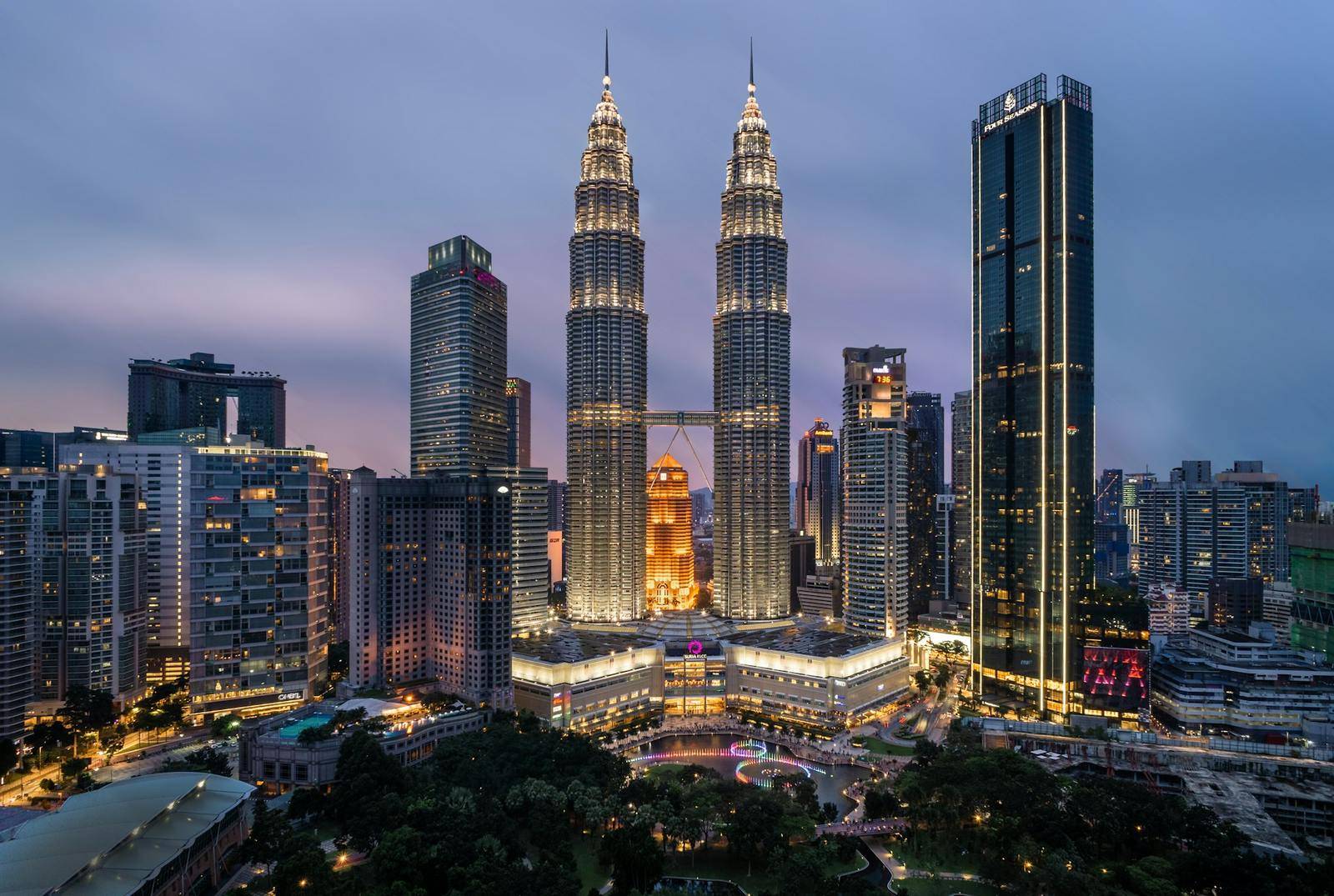
Kuala Lumpur is a tropical, leafy, sometimes congested capital, where skyscrapers, temples, mosques and colonial remnants sit side by side. English is widely used in business and parts of the service sector; Malay is the national language, Chinese and Tamil are present day to day. Food — Malay, Chinese, Indian, Peranakan — is at the centre of social life. The cost of restaurants, domestic help and many services is clearly lower than in Singapore, which changes a family’s daily life.
The climate is hot and humid, with rainy seasons. Traffic can be trying; highways and, in KL, the metro and monorail improve some journeys. The country is diverse: Penang is not KL, Johor is not Langkawi, the Cameron Highlands offer a little coolness. A plan “in Malaysia” without a choice of city has no practical content. The setting is that of a Muslim-majority federation, with real diversity and rules (alcohol, Ramadan, dress codes in some places) to be respected.
Where to live: Kuala Lumpur, Penang, Johor
Kuala Lumpur: Mont Kiara, Bangsar, KLCC, Damansara
Mont Kiara concentrates a large part of the international community and useful proximity to the Lycée français de Kuala Lumpur. Bangsar and Sri Hartamas have a neighbourhood character, restaurants, a slightly more mixed life. KLCC and the centre offer urban condominiums, closest to the towers. Damansara, Petaling Jaya and some valley communes (Subang, Shah Alam) offer more space, at the price of a commute. The choice often starts from the school and peak-hour journey times.
Penang
George Town, a heritage city, and the island of Penang attract those who want the sea, a historic setting, a famous food scene and a gentler pace than the capital. An international community is already settled there, with international schools. Private medical services are of a good standard. It is another daily life from KL, not a mere “satellite”.
Johor, Langkawi, other coasts
Johor Bahru, facing Singapore, attracts some of those who work or have ties on the other side of the causeway: daily life, border formalities and housing are not trivial, and a plan of this kind should be costed concretely. Langkawi and other coasts suit a more residential or retirement plan, with a different level of services and schools. In every case, visit, and do not decide on a brochure.
Advantages and points to watch
Advantages
- A cost of living clearly more approachable than Singapore or Hong Kong, for a complete urban daily life.
- English is widely used in Kuala Lumpur and Penang, alongside Malay and Chinese.
- The Lycée français de Kuala Lumpur and an international offer.
- Good-quality private care, often at more accessible rates than in Singapore.
- Proximity to Singapore (Johor) and a diverse country (sea, highlands, cities).
Points to watch
- The MM2H programme has been restructured several times: financial conditions should be read on the official site, not in an old summary.
- Property purchases by foreigners are subject to minimum thresholds that vary by state: check the authority of the state concerned.
- Traffic, heat and, in some areas, air quality.
- The religious and social framework (a Muslim-majority country, with real diversity) requires adaptation.
- The tax treatment of foreign-source income has seen changes: it should be reviewed with a local adviser.
Property: no listings averages, state-level rules
This page does not publish an average price per square metre drawn from portals. The national agency NAPIC publishes official market statistics: consult its latest release for index or volume trends, without confusing them with an agency average.
Purchases by a foreigner are lawful subject to conditions. Each Malaysian state in principle sets a minimum price threshold for a foreign buyer, and some properties (including part of reserved stock) may be excluded. These thresholds are not uniform across the country, and they change. They should be checked with the authority of the state where the property sits, and with a local lawyer, before any booking. A “single threshold for Malaysia” quoted from memory is not a source.
Formalities (title, charges, any approval) and transfer taxes fall under local law. Many foreign residents start by renting, while they get to know a neighbourhood — a prudence particularly justified here, where the stock of condominiums is abundant in some sectors, and of very uneven quality.
Schools and family life
The Lycée français de Kuala Lumpur, an AEFE-network school, is the anchor for French-speaking families. Admissions should be checked with the school. This page does not publish pupil numbers. International schools, in KL and Penang in particular, complete the offer. The international-school budget remains an important item, even if it is often lower than in Singapore. Family life also rests on condominiums with facilities, domestic staff frequently employed, and a social calendar already organised around the community.
How many French nationals in Malaysia?
At 1 January 2025, the French Foreign Ministry’s voluntary register recorded 2,937 enrolments in Malaysia, after 2,887 in 2024 and 3,460 in 2017. The low point of the recent series is 2,678 in 2022. Registration is voluntary: these counts understate the actual community. They correct rounded ranges sometimes quoted without a source.
Registration on the register of French nationals established outside France is voluntary. These official counts therefore understate the actual community. Source: French Foreign Ministry, community CSV files, registrations at 1 January.
Residency, formalities and healthcare
Long-term residence may rest on a work permit, dependant status, or the Malaysia My Second Home (MM2H) programme, restructured several times, with tiers and financial conditions published by the government. This page does not freeze a deposit or income amount that would belong to an old version. The official conditions in force — and they alone — are authoritative. Other schemes may exist; they should be read at source.
Private healthcare, in Kuala Lumpur and Penang, is of a good standard, often at more accessible rates than in Singapore. Suitable insurance remains essential. The public sector exists; a foreign resident’s path frequently relies on the private sector.
Tax in 2026 — what is useful to know next
The tax authority (LHDN) administers income tax. The treatment of foreign-source income remitted to Malaysia has seen notable changes in recent years; the rules in force, and any temporary or permanent exemptions, should be read on the official pages and confirmed with an adviser, at the date of your plans. Tax treaties frame double taxation.
If you leave France, the French exit tax on certain unrealised gains may apply. A departure outside the European Union does not, in principle, benefit from the automatic deferral available within the EU: guarantees or other conditions may be required. The impots.gouv.fr page (updated on 10 March 2026) is the starting point; a proposal to extend the period to fifteen years is not in force. Have your position reviewed by an adviser.
A Malaysia plan should be built in this order: the city, the school, a home often rented first, a residence title whose conditions have been reread as they now stand, then a tax review. The memory of an “easy MM2H” is not a basis for a decision.
Frequently asked questions
How many French nationals live in Malaysia?
At 1 January 2025, the French Foreign Ministry’s voluntary register recorded 2,937 enrolments in Malaysia, after 2,887 in 2024 and 3,460 in 2017. The series reached a low of 2,678 in 2022, then recovered a little. Registration is voluntary: these counts understate the actual community, concentrated in particular in Kuala Lumpur (Mont Kiara, Bangsar) and, to a lesser extent, in Penang.
What is the MM2H programme?
Malaysia My Second Home (MM2H) is a long-term residence programme, restructured several times in recent years, with several tiers and financial conditions published by the Malaysian government. The criteria (deposit, income, age, duration, possibly a property purchase) have changed more than once. This page does not freeze an amount that would belong to an old version. Read the official conditions in force on the programme / immigration website, and have them confirmed.
Can a foreigner buy a home?
Yes, subject to conditions. Each Malaysian state in principle sets a minimum purchase threshold for foreigners, and some types of property (including part of the stock reserved for Malays) may be excluded. The threshold and formalities should be checked with the authority of the state where the property sits. This page does not publish a listings average or a single invented threshold for the whole country. NAPIC (the national agency) publishes official market statistics: consult its latest release for trends, without confusing them with an agency average price.
Where should I settle?
Kuala Lumpur (KLCC, Bangsar, Mont Kiara, Damansara, Sri Hartamas) concentrates the international community and the French lycée. Penang offers the sea, a heritage setting and a gentler pace. Johor Bahru attracts in part through proximity to Singapore. Langkawi and other coasts suit a more residential plan, with a different daily life of services.
Where can children go to school?
The Lycée français de Kuala Lumpur, an AEFE-network school, is the French-speaking anchor. International schools complete the offer, in Kuala Lumpur and Penang in particular. Admissions should be checked with the schools. This page does not publish pupil numbers.
What is the tax framework?
The Malaysian tax authority (LHDN) administers income tax. The treatment of foreign-source income remitted to Malaysia has seen changes in recent years; the rules in force, and any exemptions, should be read on the official pages and confirmed with an adviser. A tax treaty with France (and, where relevant, with the United Kingdom) frames double taxation.
Are you thinking of moving to Malaysia?
Leave your details and we can talk through the practical side of your plans — city, housing, schools, formalities. A personal conversation, with no obligation.