
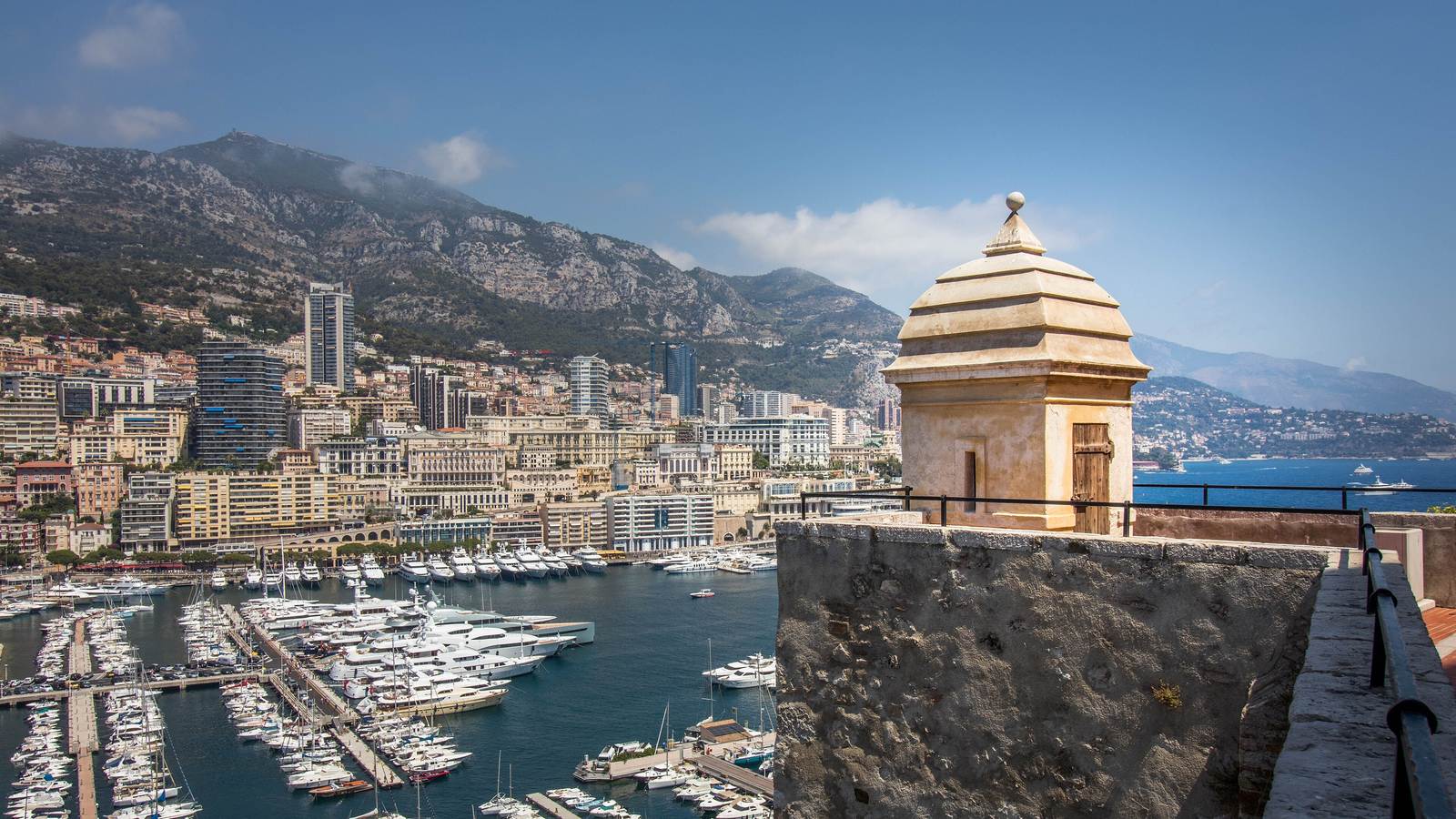

In 2026, Monaco remains a destination apart: a sovereign state of a few square kilometres, squeezed between sea and hills, where security, setting and the density of services are exceptional — and where housing is among the most expensive in the world. People come first for that way of life, for the sea, for a human-scale daily routine and for proximity to Nice and Italy. Tax, often put forward, is a second subject, and a particularly delicate one for French nationals.
This guide covers lifestyle, neighbourhoods, official IMSEE figures on population and property, schools, residence formalities and then the tax framework — carefully distinguishing what applies to French nationals from what applies to other nationalities. For another European purchase walk-through, you may also read our article on buying a home in Portugal.
Lifestyle and everyday life
The Principality can be crossed in a short time, from Port Hercule to Larvotto, from La Condamine to Fontvieille, from Monte-Carlo to the Rock. Daily life is urban, well kept, very safe, and strongly organised around the sea, events (the Grand Prix, Monte-Carlo, the cultural seasons) and a relatively older resident population, joined each day by a large flow of employees who live outside Monaco, especially in the neighbouring French communes.
French is the official language; English is widely used in services, international schools and parts of business. The climate is Mediterranean, milder than inland. Nice Côte d’Azur airport is the real international gateway, some twenty kilometres away — an advantage, provided journeys are planned. Shops, doctors and errands all sit in a very small perimeter; the other side is the lack of space, the cost, and a certain social visibility.
Many families combine Monaco with the French or Italian hinterland for weekends, the mountains or a more spacious home. That arrangement is practical; it should not be confused with tax residence or a residence card, which are assessed on the actual place of abode.
Where to live: Monte-Carlo, Fontvieille, Larvotto, Condamine
Monte-Carlo and the Carré d’Or
Monte-Carlo, around the casino, the hotels and the Carré d’Or, remains the Principality’s best-known image: prestigious buildings, views, services, and some of the highest prices. Stock is scarce, transactions often unusual, and daily life more social. It is a market in which every detail — floor, sea view, parking spaces, common parts — weighs heavily on the price, which IMSEE now also documents by district in its observatory (see the report for a sector-by-sector breakdown).
Larvotto and La Rousse / Saint-Roman
To the east, Larvotto offers the beach, more recent buildings and a slightly more residential pace. La Rousse and Saint-Roman, up the slopes, give more views and sometimes a little more quiet, with gradients and access to take into account day to day, especially with children.
Fontvieille and Mareterra
Fontvieille, a district reclaimed from the sea, is more modern, organised around the marina, the stadium and local shops. It appeals to those who want a slightly more “neighbourhood” way of life in a tiny state. The Mareterra extension (the former Anse du Portier) has added a new waterfront: it is a very high-end segment, whose transactions weigh on averages. IMSEE has specifically changed its method for calculating the price per square metre in order to better reflect these recent properties when they come back to market.
La Condamine, the Rock, Moneghetti and Jardin Exotique
La Condamine, around the market and Port Hercule, has a more lively, everyday character. The Rock (Monaco-Ville) is the historic heart, quieter in the evening, with the palace and museums. Moneghetti and Jardin Exotique, on the heights, offer views and housing that is sometimes a little more approachable than the Carré d’Or — “approachable” remaining highly relative in Monaco. In every case, visiting, measuring the gradient and checking parking are essential.
Some of those who work or spend their days in Monaco live in Beausoleil, Cap-d’Ail or Roquebrune. These communes are French. They can suit a housing budget, but they do not make you a Monegasque resident. That distinction, often blurred in casual conversation, must stay clear in a relocation plan.
Advantages and points to watch
Advantages
- Among the highest levels of security in the world, and a setting of sea and hills on only a few square kilometres.
- French-curriculum schooling (the public system is aligned with French national education) and international schools.
- Proximity to Nice airport, the Côte d’Azur and Italy, with a bilingual French–English daily life.
- No Monegasque income tax for residents who fall outside the 1963 Franco-Monegasque convention — a point that does not apply in the same way to French nationals.
- High-quality services, the Princess Grace Hospital (CHPG), and a carefully maintained environment.
Points to watch
- An extremely tight and expensive property market: €57,569 per square metre in 2025 according to IMSEE, with limited stock.
- For French nationals, the 1963 tax convention generally keeps them taxable in France.
- Housing, residence-card formalities and the cost of daily life are demanding filters.
- The territory is tiny: everyday life often spills into Beausoleil or Cap-d’Ail, which is not Monegasque residence.
- The French community is slowly declining according to IMSEE, and daily life is highly socially visible.
Property: official IMSEE figures for 2025
The Monegasque Institute of Statistics and Economic Studies (IMSEE) publishes a Property Observatory, presented on 18 February 2026 for 2025 data. That is the official source used here — not listing-website averages.
In 2025 the market recorded 493 transactions, up 5.8% on 2024. The total value of sales and resales stands at €5.9 billion, a level stable relative to the previous year’s record. The price per square metre, after a sharp rise in 2024 to €58,402 (+14.8% on 2023), eased by 1.4% in 2025, to €57,569, “a historically high level” according to the Princely Government’s press release.
IMSEE has also changed its method: the calculation now rests on a linear regression model applied to all transactions for which the floor area is known, taking into account both sales and resales and the period of construction. The change is intended to handle better the effect of new buildings quickly resold. Comparisons with earlier years should therefore be read with this methodological caveat. The observatory also allows, according to the press release, an estimate of the average price per square metre by district and by decade of construction: the detail is in IMSEE’s report, which you should consult for a specific sector.
Buying in Monaco involves a notary, title checks, and often very little competition among properties simply because so few are available. Fees, co-ownership rules and parking spaces should be costed with a local professional. Non-residents may buy, subject to Monegasque formalities; owning a property is not, on its own, equivalent to a residence card.
Schools and family life
The Principality’s public education system is closely aligned with the French national curriculum, which is a major advantage for a family coming from France: Lycée Albert Ier is the emblematic school. Private schools complete the offer, including Institution François-d’Assise-Nicolas-Barré, and the International School of Monaco for an international curriculum. Admissions, fees and places should be checked directly with the schools. This page does not publish pupil numbers.
Family life takes place in a very small, very safe space, with the sea close by and a dense calendar of activities. The other side is cost, the scarcity of spacious family homes, and the occasional need to rely on the hinterland for sport or weekends. The home-and-school pair remains, as elsewhere, the structural decision — with a tighter stock constraint than in Madrid or Lisbon.
How many French nationals in Monaco?
Two official series should be held together, and not mixed. According to IMSEE (2025 census, report of May 2026; Monaco en Chiffres 2026), the Principality had 38,857 residents at 31 December 2025, 434 more than a year earlier (+1.1%). French nationals remain the second nationality, with 8,270 people (21.3%), behind Monegasques (9,333, or 24.0%) and ahead of Italians (7,559) and British nationals (3,081). In 2024 there were 8,371 French residents; in 2016, 9,286. The annual fall from 2024 to 2025 is 1.2%. Since 2016, residents with more than one nationality have been counted in each community matching their nationalities (6.9% of French residents were multinational in 2025); Monegasques are counted only as Monegasque. The census method changed in 2023: long comparisons should remain cautious.
The French Foreign Ministry’s voluntary register gives another figure: 5,656 registrations at 1 January 2025, down from 7,728 in 2017. The gap with IMSEE is explained by the voluntary nature of the register, by the date, and by different concepts. Both sources are official; neither is “adjusted” here by an estimate.
| Source | Reference date | French headcount |
|---|---|---|
| IMSEE, population census | 2016 | 9,286 |
| IMSEE, population census | 31 December 2024 | 8,371 |
| IMSEE, population census | 31 December 2025 | 8,270 (21.3% of the population) |
| French Foreign Ministry, voluntary register | 1 January 2025 | 5,656 |
These two sources do not measure the same thing. IMSEE counts residents under a register-based method since 2023 (comparisons with censuses before 2023 should be read with caution). People with more than one nationality are counted in each relevant nationality, except Monegasques, who are counted only as Monegasque. The French Foreign Ministry register is voluntary and understates the community. Sources: IMSEE, 2025 Census (report, May 2026) and Monaco en Chiffres 2026; French Foreign Ministry, community files.
Registration on the register of French nationals established outside France is voluntary. These official counts therefore understate the actual community. Source: French Foreign Ministry, community CSV files, registrations at 1 January.
Residency, formalities and healthcare
Settling in Monaco is not an automatic right, including for a French national. A residence card is issued by the Monegasque authorities, in practice on evidence of housing (a lease or title) and of means, under conditions that vary with the purpose (employment, self-employment, family) and nationality. Applications are made to the Department of Public Security. The official pages of the Princely Government are authoritative. Finding a home, in such a tight market, is often the step that sets the timetable.
Healthcare rests in particular on the Princess Grace Hospital Centre (CHPG). Some specialties may lead to Nice. Affiliation to a social-security scheme (a Monegasque fund, or, in some career or personal situations, a link with the French scheme) should be examined case by case. Complementary insurance is common. This is not a subject to settle “on average”.
Tax in 2026 — what is useful to know next
The central point, for a French reader, is not “the absence of income tax in Monaco”. The Franco-Monegasque tax convention of 18 May 1963 provides, as a general rule, that individuals of French nationality who transfer their domicile to the Principality remain taxable in France on all their income, as if they had kept their tax domicile there. Narrow exceptions exist, linked in particular to historical situations; they should not be assumed. The convention and administrative practice should be read with an adviser, in light of your nationality (including a dual nationality), the date you settle and your history.
For residents who fall outside that scope — including many nationalities other than French — the Principality does not apply a personal income tax comparable to French income tax, nor a wealth tax of the IFI type. That does not erase tax in other states (including the United Kingdom, depending on residence status), nor rules on companies, nor transfer or inheritance taxes, which should be examined separately. Monaco is not an EU Member State; the French exit-tax rules applicable to a departure for the Principality are not those of automatic intra-EU deferral.
If you leave France, the French exit tax on certain unrealised gains may apply. A departure outside the European Union does not, in principle, benefit from the automatic deferral available within the EU: guarantees or other conditions may be required. The impots.gouv.fr page (updated on 10 March 2026) is the starting point; a proposal to extend the period to fifteen years is not in force. Have your position reviewed by an adviser.
A Monaco plan should therefore be built in this order: a real home and a residence card, a school if needed, then a precise tax review — nationality by nationality — before any break of domicile. Living on the other side of the border, in Beausoleil, is not a substitute.
Frequently asked questions
Are French nationals taxed in Monaco?
Under the Franco-Monegasque tax convention of 18 May 1963, individuals of French nationality who transfer their domicile to the Principality generally remain taxable in France on all their income, as if they had kept their tax domicile there. The absence of Monegasque income tax, often highlighted, therefore does not apply in the same way to French nationals. The convention and the tax authority’s practice should be reviewed with an adviser, in light of your nationality, your history and the date you settle.
How many French people live in Monaco?
Two official figures, which do not measure the same thing, should be distinguished. At 31 December 2025, IMSEE counted 8,270 French residents (21.3% of the population), compared with 8,371 at the end of 2024 and 9,286 in 2016. At 1 January 2025, the French Foreign Ministry’s voluntary register recorded 5,656 enrolments. At IMSEE, people with more than one nationality are counted in each nationality (except Monegasques).
What is the official property price in Monaco?
According to IMSEE’s Property Observatory for 2025 data, presented on 18 February 2026, the price per square metre stands at €57,569 in 2025, a slight fall of 1.4% from €58,402 in 2024 (a year that had seen a 14.8% rise). IMSEE has changed its calculation method (a regression model, sales and resales, period of construction). 493 transactions were recorded in 2025 (+5.8%), for a total value of €5.9 billion.
Can I live in Beausoleil and “be in Monaco”?
No. Beausoleil, Cap-d’Ail and Roquebrune-Cap-Martin are French communes. Living there can be more accessible for housing, but it does not confer Monegasque residence or the associated regime. Tax residence and a Principality residence card are separate questions, to be handled with precision.
How do I obtain a residence card?
Settling in the Principality typically requires housing, sufficient means and an application for a residence card to the Monegasque authorities (Public Security). The exact conditions, which vary by nationality and purpose (employment, self-employment, family), are on the official pages of the Princely Government. A lease or a title deed is in practice essential, in a very tight market.
Where can children go to school in Monaco?
Monegasque public education is closely aligned with the French curriculum (including Lycée Albert Ier). There are also private schools, including Institution François-d’Assise-Nicolas-Barré, and the International School of Monaco. Admissions should be checked directly with the schools. This page does not publish pupil numbers.
Are you thinking of moving to Monaco?
Leave your details and we can talk through the practical side of your plans — housing, formalities, schools. A personal conversation, with no obligation.